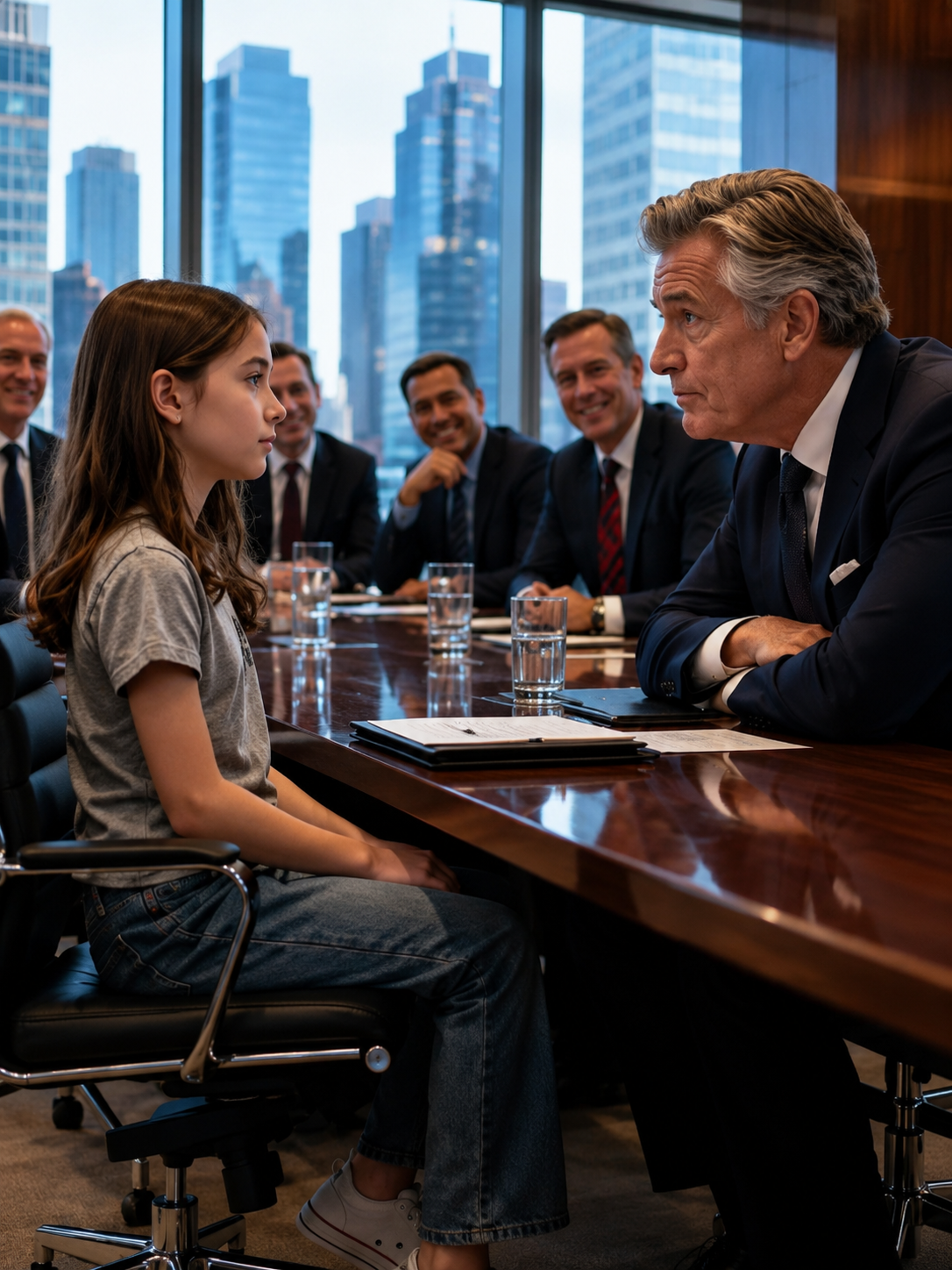
“Go ahead,” Richard Hoffman said with a mocking smile. “Tell me which seven languages you supposedly speak.”
The headquarters of the international company had turned into a battlefield of broken dreams since early morning. Inside the towering glass building, candidates waited in the elegant lobby holding folders and laptops, their confidence fading with every interview that ended.
Every few minutes, another applicant came out looking crushed. One man adjusted his tie nervously while whispering into his phone about rejection. A young woman hurried to the elevator, wiping tears from her eyes. Even experienced professionals left the conference room stunned and discouraged.
The reason was clear: Richard Hoffman himself conducted the final interviews.
Known in the business world for his merciless standards, Richard offered no second chances. Seated at a long conference table with department directors, he tested candidates with tough questions, often switching languages without notice.
“Next,” the tired secretary announced.
A murmur spread through the lobby at once.
Instead of another executive or seasoned expert, a girl who appeared no older than twelve stood up calmly from her chair.
She wore faded jeans, a gray T-shirt, and worn sneakers. A thin folder rested in her hands. She seemed far too young for a place like this, yet she walked toward the conference room without any trace of fear.
“Is she lost?”
“Someone’s daughter?”
“Maybe she’s here on a school trip.”
Quiet laughter followed her to the door.
The moment she entered, the room fell silent.
Richard slowly looked up from his papers and stared at her.
Then he smirked.
“Little girl, I think you’re in the wrong room.”
A few managers chuckled.
The girl calmly took a seat across from him.
“No,” she replied. “I’m here for the interview.”
More laughter echoed around the table.
“What position?” one manager asked sarcastically. “Chief Executive Officer?”
The girl didn’t even blink.
“I speak seven languages. I’m applying to work as a translator for international contracts.”
The room erupted.
“Seven languages?”
“Seriously?”
“Do you even speak English properly?”
Richard folded his arms.
“Fine. Which languages?”
“English, German, French, Spanish, Russian, Chinese, and Italian.”
The laughter grew louder.
“Of course.”
“And I suppose you taught yourself all of them?”
For the first time, the girl’s eyes narrowed slightly.
Then, without hesitation, she turned toward the directors one by one and began speaking.
English.
German.
French.
Spanish.
Russian.
Chinese.
Italian.
The room went silent.
Smiles vanished.
Chairs stopped moving.
Richard Hoffman slowly leaned forward as the girl opened her folder, revealed a document no one expected her to have, and spoke a sentence that made every person at the table freeze in absolute shock…

Part 2: The Contract That Buried a Billionaire
“This contract was not mistranslated,” the girl said, her voice calm as snowfall over a grave. “It was deliberately poisoned.”
For one perfect, terrible second, nobody in the conference room moved.
The sentence hung in the air like a blade.
Richard Hoffman’s mocking smile vanished so completely that it seemed to have belonged to another man. Around him, the department directors stared at the thin folder in the girl’s hands as though she had just placed a bomb on the polished table.
The girl sat upright in her chair, small, pale, and impossibly composed. Her faded sneakers did not reach the floor. Her gray T-shirt looked absurd beneath the crystal lights and steel-framed company portraits. Yet every adult in that room suddenly looked smaller than she did.
Richard’s eyes narrowed.
“What did you say?”
The girl slid a document forward with two fingers.
“I said this contract was deliberately poisoned.”
The legal director, Martin Keller, gave a nervous laugh.
“That is an extremely serious accusation.”
“Yes,” the girl replied. “That is why I waited until I was in a room with witnesses.”
A hush fell again.
The directors exchanged glances.
Richard did not touch the document at first. His gaze remained fixed on the child.
“What is your name?”
“You read my application.”
“I asked you to say it.”
The girl’s expression remained unchanged.
“Evelyn Ward.”
Richard’s jaw tightened almost imperceptibly.
“Evelyn Ward,” he repeated. “And how did a twelve-year-old child get her hands on confidential company documents?”
“I’m not twelve.”
Someone coughed awkwardly.
Richard leaned back. “Then how old are you?”
“Sixteen.”
“You look twelve.”
“I know.”
Her answer was so plain, so unbothered, that one of the junior directors lowered his eyes, ashamed of having laughed earlier.
Richard finally pulled the document toward him.
The moment he saw the header, the color drained from his face.
Hoffman Global — Strategic Acquisition Agreement
Translation File: Volkov-Ming Energy Holdings
Classification: Executive Confidential
Martin Keller stood at once.
“That file should not exist outside the executive archive.”
“It exists in several places,” Evelyn said.
Martin’s mouth opened, then closed.
Richard looked up slowly.
“Explain.”
Evelyn folded her small hands on the table.
“You hired external translators three months ago for the Volkov-Ming acquisition. The agreement was written primarily in Russian and Mandarin, then adapted into English, German, and French for the executive board. According to the official English version, Hoffman Global receives majority operational control within eighteen months.”
“That is correct,” Richard said.
“No.” Evelyn tapped the document. “That is what the English version says.”
A murmur traveled around the room.
She continued, voice steady.
“The Russian original contains a conditional clause not present in the English version. The Mandarin annex contains a financial obligation hidden under a technical licensing paragraph. The French summary omits both. Together, these clauses mean something very different from what your board approved.”
Richard stared at her.
Evelyn leaned forward slightly.
“If Hoffman Global signs this agreement tomorrow, you will not acquire Volkov-Ming. Volkov-Ming will acquire you.”
The room exploded.
“That’s impossible!”
“Absolutely impossible.”
“Who reviewed the clauses?”
“Legal approved it.”
“International affairs approved it!”
Martin Keller slammed his hand on the table.
“Enough. This is absurd. Mr. Hoffman, with respect, we are listening to a child making accusations about a billion-dollar contract she could not possibly understand.”
Evelyn turned to him.
In flawless German, she said, “Herr Keller, paragraph seventeen, subclause four, line nine. You translated Übertragungspriorität as transfer priority. In context, it means succession priority of controlling interest. That is not a mistake a legal translator should make.”
Martin froze.
She turned a page.
“In Russian, право обратного контроля does not mean right of review. It means right of reversed control. In Mandarin, the phrase you accepted as shared infrastructure licensing refers to compulsory debt assumption under cross-border acquisition law.”
Her eyes returned to Richard.
“Someone wanted you to misunderstand your own victory.”
The glass walls seemed to close in.
Richard’s fingers tapped once on the table. Only once. Everyone who knew him understood that single tap was more dangerous than shouting.
“Who?”
Evelyn looked around the room.
“That is why I came here.”
Martin forced another laugh, but this time it trembled.
“This is theatrical nonsense.”
“No,” Evelyn said. “The theatrical part was when you laughed at me.”
Nobody laughed now.
Richard stood.
His chair rolled backward with a soft hiss over the carpet.
“Everyone out.”
The directors stiffened.
Martin protested immediately. “Richard, this concerns legal—”
“Out.”
“But—”
Richard’s head turned slowly toward him.
“Martin.”
One word. Cold enough to frost the table.
Martin swallowed.
One by one, the directors gathered their folders and left. Some looked at Evelyn with curiosity. Some with fear. Martin looked at her with hatred.
When the door shut, only Richard Hoffman, Evelyn Ward, and the silent city beyond the glass remained.
Richard did not sit down again.
“Start from the beginning.”
Evelyn opened her folder wider.
“My father was Daniel Ward.”
Richard’s face changed.
Not dramatically. Richard Hoffman was too controlled for that. But his eyes flickered, and for a fraction of a second, the ruthless mask cracked.
Daniel Ward had been Hoffman Global’s most gifted linguistic strategist. Five years earlier, he had negotiated impossible trade agreements across three continents. He was brilliant, quiet, and famously loyal.
Then came the scandal.
A leaked translation error destroyed a merger in Shanghai. Hoffman Global lost hundreds of millions. Daniel Ward was accused of negligence, breach of confidentiality, and manipulating language to favor a rival company. Before he could defend himself, he died in a car crash on a rainy highway outside Geneva.
The newspapers called it guilt.
Richard had called it betrayal.
Evelyn’s voice softened for the first time.
“My father did not betray you.”
Richard’s expression hardened.
“You were eleven.”
“I was old enough to know when adults were lying.”
“You cannot prove what happened five years ago.”
“I couldn’t,” she said. “Not then.”
“And now?”
She slid another page across the table.
Richard looked down.
It was a photograph.
Daniel Ward stood in a hotel corridor beside Martin Keller. Between them was a folder stamped with the same executive confidentiality mark now printed on the Volkov-Ming contract.
The timestamp was the night before Daniel died.
Richard’s breathing changed.
“Where did you get this?”
“My father sent it to me.”
“He was dead before the scandal broke.”
“He knew something was coming.”
Evelyn’s fingers tightened slightly in her lap.
“He left pieces everywhere. Letters hidden inside language books. Audio files disguised as pronunciation lessons. Draft contracts with deliberate markings. For years I thought they were grief. Then I realized they were instructions.”
Richard lowered himself slowly into his chair.
His voice was no longer mocking.
“What instructions?”
“To learn the languages they used to bury him.”
The words struck harder than any accusation.
For a long moment, Richard said nothing.
The giant office tower groaned faintly in the wind. Far below, traffic crawled between steel and stone, unaware that an empire might be collapsing above it.
Evelyn pulled out seven slim notebooks, each worn at the corners.
“One for each language. My father believed language was the safest hiding place because arrogant people only hear what they expect to hear.”
Richard’s eyes moved over the notebooks.
“And you learned all seven?”
“Yes.”
“For revenge?”
Evelyn looked at him.
“For truth.”
Something unreadable crossed Richard’s face.
He had built his life on force. Companies surrendered to him. Rivals feared him. Employees obeyed him. He had never believed in ghosts, mercy, or children with storm-gray eyes.
Yet sitting across from him was the daughter of a man he had condemned, holding documents that could destroy everything he thought he knew.
He reached for the internal phone.
Evelyn spoke before he could press a button.
“Do not call legal.”
Richard’s hand paused.
“Why?”
“Because legal is compromised.”
“Martin?”
“At least Martin.”
“At least?”
She opened another page.
“Security. International acquisitions. A board liaison. Possibly someone in your family office.”
Richard’s face darkened.
“My family office?”
Evelyn did not flinch.
“The altered clauses were not simply hidden. They were routed through internal approvals with executive access credentials. Your signature process was studied. Someone close to you knew exactly how impatient you are when you believe you have already won.”
That sentence landed with brutal accuracy.
Richard stood again and walked to the window.
The city glittered beneath him, proud and indifferent. For years, he had loved that view because it made people look like pieces on a board. But now, reflected faintly in the glass, he saw not a king, but a man who might have been moved by someone else’s hand.
“Why come to me?” he asked.
“Because tomorrow morning you sign the agreement.”
“You could have gone to the press.”
“And let Volkov-Ming trigger the emergency clause before you understood the trap?”
“You could have gone to the police.”
“With what? A child’s translation notes?”
“You could have done nothing.”
Evelyn’s voice dropped.
“Martin Keller visited my mother two weeks after my father died. He told her that grief makes women imagine conspiracies. He told her if she kept asking questions, I would grow up without both parents.”
Richard turned.
Evelyn’s eyes shone now, not with tears, but with something sharper.
“My mother stopped asking questions. She died last winter still afraid of a man everyone here calls respectable.”
The silence after that was not empty. It was crowded with the dead.
Richard’s expression became unreadable again, but his voice was lower.
“What do you want from me?”
“I want access to the original executive archive.”
“No.”
“Then sign tomorrow and lose your company.”
His eyes flashed.
“You do not threaten me.”
“I am not threatening you, Mr. Hoffman. I am translating consequences.”
For the first time in years, Richard Hoffman almost smiled without cruelty.
Almost.
Then the conference room door opened.
Martin Keller stepped inside.
He had not knocked.
“Apologies,” Martin said smoothly. “But this has gone far enough.”
Richard turned slowly.
“I told everyone to leave.”
Martin smiled.
“And I thought perhaps you would appreciate adult supervision before making decisions based on the fantasies of Daniel Ward’s daughter.”
Evelyn did not move.
Richard said, “How long were you listening?”
Martin’s smile sharpened.
“Long enough.”
The hallway behind him was empty, but Evelyn noticed the way Martin’s right hand remained near his jacket pocket. She also noticed the tiny black device clipped beneath his cuff.
A recorder.
No, not just a recorder.
A transmitter.
Richard noticed Evelyn’s gaze.
His face hardened.
Martin saw it too and sighed.
“Richard, do not be dramatic. You have always mistaken suspicion for intelligence.”
Richard said nothing.
Martin stepped farther into the room.
“Let me make this simple. That girl is the unstable child of a disgraced employee. Any document she has is stolen. Any claim she makes is inadmissible. Any damage she causes will be blamed on her, and frankly, on you for entertaining her.”
Evelyn spoke softly.
“Did you say the same thing to my father before he died?”
Martin looked at her.
His smile vanished.
“You look like him.”
“People keep saying that.”
“It is not a compliment.”
“I know. From you, it would be contamination.”
Martin’s eyes chilled.
Richard’s voice cut through the room.
“Answer her.”
Martin laughed once.
“You cannot be serious.”
“Answer her.”
Martin adjusted his cuffs.
“All right. Here is an answer. Daniel Ward was weak. Brilliant, yes. But weak. He discovered things he had no authority to question. He thought truth mattered more than structure. Men like that are dangerous in companies like this.”
The words were careful. Too careful.
Evelyn leaned forward.
“So you framed him.”
Martin looked at Richard.
“Listen to her. She wants a confession because she has nothing.”
Richard’s gaze flicked toward Evelyn.
She gave the smallest shake of her head.
Not yet.
Richard understood.
He sat down again and folded his hands.
“Martin, explain the Volkov-Ming clauses.”
Martin’s face changed.
Only slightly. But enough.
“What clauses?”
“The reversed control clause. The debt assumption clause. The omitted succession language.”
Martin was silent for half a heartbeat.
Then he smiled.
“Ah. Those clauses.”
Richard’s fingers stopped moving.
Martin walked to the table and placed both palms on it.
“You were never meant to find them before signing.”
The air became ice.
Evelyn’s heart hammered, but her face remained still. She could feel the tiny device sewn inside the hem of her folder vibrating gently.

Recording.
Broadcasting.
Not to the police.
Not to the press.
To someone far more dangerous.
Martin looked at Richard with open contempt now.
“Do you know what your problem has always been? You believe fear is loyalty. You humiliate people, crush rivals, burn careers, and then call yourself a builder. Half this company hates you. The other half is waiting for your shadow to move so they can breathe.”
Richard’s face revealed nothing.
Martin continued, bolder now.
“Volkov-Ming understood that. They understood that an empire built around one man can be acquired by acquiring his blind spots.”
“And you sold them mine,” Richard said.
Martin smiled.
“I sold them access.”
Evelyn’s fingers tightened around the edge of the folder.
Richard’s voice remained controlled.
“Daniel discovered this five years ago.”
“Daniel discovered an earlier structure. Not this one. He was clever, but sentimental.” Martin’s eyes moved to Evelyn. “He hid evidence badly. In children’s books. In language games. In little messages to his little girl.”
Evelyn’s throat closed.
Martin noticed.
His smile returned.
“Yes. I found some of them.”
Richard stood so suddenly his chair struck the wall.
Martin did not flinch.
“You killed him,” Richard said.
Martin tilted his head.
“I did not touch the car.”
“Who did?”
“People who understood discretion.”
Evelyn’s vision blurred for one second.
The room stretched. The lights became too bright. Her father’s voice rose from memory: Say the sentence again, Evie. Language is a lock. Meaning is the key.
She forced herself to breathe.
“Why?” she asked.
Martin looked at her with irritation, as though she were a stain on the carpet.
“Because your father refused an offer.”
“What offer?”
“To join us.”
“Us?” Richard said.
Martin’s gaze flicked to him.
And then Evelyn knew.
Not just Martin.
Not just Volkov-Ming.
Something larger.
Martin smiled with genuine pleasure.
“You still think this is about one acquisition.”
The city outside flashed with distant lightning though no storm had been forecast.
Martin straightened his jacket.
“There are companies that build products. Companies that move money. Companies that own land. And then there are organizations that own the language inside those agreements. One word moved from one clause to another, one ambiguity placed where trust is expected, one translation softened for a board too arrogant to read the original — and entire nations sign away their futures.”
Richard stared at him.
Martin’s voice lowered.
“Daniel found the edge of it. He thought it was corruption. He did not understand it was architecture.”
Evelyn whispered, “The Black Lexicon.”
Martin’s eyes snapped to her.
For the first time, he looked afraid.
Richard turned toward Evelyn.
“What did you say?”
Evelyn’s lips felt cold.
“The phrase appeared in one of my father’s notebooks. I thought it was a metaphor.”
Martin moved fast.
His hand went into his jacket.
Richard lunged across the table, but Martin had already drawn a small black pistol.
The room froze.
Evelyn did not scream.
Martin aimed not at Richard, but at her.
“Give me the folder.”
Richard’s voice became deadly quiet.
“Martin.”
“Sit down.”
“You will not leave this building.”
Martin laughed.
“I already have.”
Then the lights went out.
The conference room plunged into darkness.
For half a second, there was only the hum of emergency power failing somewhere above them.
Then chaos erupted.
A gunshot cracked through the black.
Glass shattered.
Someone shouted.
Evelyn dropped under the table, clutching the folder to her chest. Her knees slammed into the carpet. Pain shot up her legs. She heard Richard curse, heard Martin stumble, heard another sound that did not belong in the room at all.
The click of the door unlocking from the outside.
Red emergency lights flickered on.
The conference room appeared in pulses of blood-colored light.
Martin stood near the table, pistol raised.
Richard was by the window, one hand pressed to his upper arm. Blood darkened his sleeve.
And in the doorway stood the building’s night security supervisor, a heavyset woman named Ada Brooks, holding a stun baton and looking extremely unimpressed.
“Drop it, Keller,” Ada said.
Martin turned the gun toward her.
Evelyn screamed, “Russian!”
Ada’s eyes sharpened.
Richard did not understand.
Martin did.
For one fraction of a second, his attention snapped back toward Evelyn.
Ada moved.
The stun baton struck Martin’s wrist with a violent crack. The pistol fired into the ceiling. Martin cried out. Richard surged forward and slammed him against the wall with a force that shook the glass.
The gun skidded across the carpet.
Ada kicked it under the table.
Evelyn grabbed it with shaking hands, then immediately pushed it farther away, disgusted by the cold metal.
Martin struggled, but Richard pinned him by the throat.
“Who sent you?” Richard snarled.
Martin’s face purpled.
Ada stepped forward.
“Sir, don’t kill him.”
Richard’s hand tightened.
“Who?”
Martin choked out a laugh.
“Too late.”
Then his eyes moved to Evelyn.
And he smiled.
Not triumphantly.
Pityingly.
“You have no idea what your father really was.”
Evelyn went still.
Richard released him just enough for air.
“What does that mean?”
Martin coughed, blood at his lip.
“It means Daniel Ward did not stumble onto the Black Lexicon.”
His smile widened.
“He helped create it.”
Evelyn felt the world tilt.
“No.”
Martin laughed harder.
“Ask her what the seventh notebook says, Richard.”
Evelyn’s hands went numb.
Richard turned slowly toward her.
“What seventh notebook?”
Evelyn swallowed.
“There were seven language notebooks.”
“No,” Martin wheezed. “Not those. The seventh real notebook. The one her mother hid from her. The one Daniel never meant for his precious daughter to read until she was old enough to understand inheritance.”
Evelyn’s mouth dried.
“My mother didn’t hide anything.”
Martin’s gaze glittered.
“She hid it in the piano.”
The words struck Evelyn like a physical blow.
The piano.
Her mother’s old upright piano, the one with the broken middle C. After her mother died, Evelyn had sold nearly everything to survive, but not the piano. Never the piano. It sat in their small apartment beneath a white sheet, silent and waiting.
Richard stared at her, searching her face.
Evelyn could not hide the truth.
She had not known.
Ada grabbed Martin’s wrists and fastened plastic restraints around them.
“The police are on their way,” Ada said.
Martin smiled again.
“No. They are not.”
Ada’s radio crackled.
Static.
Then a voice came through.
“Security lockdown initiated. Executive floor sealed. Await internal resolution.”
Ada’s face hardened.
“That’s not my team.”
Richard looked toward the door.
From somewhere beyond the conference room came the soft, synchronized sound of elevator doors opening.
Then footsteps.
Many footsteps.
Ada moved quickly.
“Back exit.”
Richard grabbed the Volkov-Ming document. Evelyn gathered her folder. Ada led them through a side door hidden behind a panel of walnut shelving.
Behind them, Martin called out, voice echoing down the red-lit room.
“Run, Evelyn! That is what children do best!”
The hidden passage was narrow and smelled of dust and wiring. Emergency lights blinked along the ceiling. Richard moved heavily, blood dripping from his sleeve, but his face was carved from stone.
Evelyn followed behind Ada, clutching the folder so hard the edges bent.
The building groaned around them.
“Who are you really?” Richard asked Ada.
“Security supervisor.”
“Do security supervisors usually interrupt assassinations?”
Ada did not look back.
“No. Usually I file reports about people microwaving fish in the staff lounge.”
Evelyn almost laughed. It came out like a sob.
Ada glanced at her.
“You did well.”
“I screamed one word.”
“You screamed the right one.”
Richard’s eyes narrowed.
“You understood her?”
Ada said, “I speak Russian.”
Richard stared.
Ada shrugged. “Some people have lives before badges.”
They reached a service stairwell. Ada opened the door carefully.
Voices echoed below.
Men. Calm. Professional.
Ada closed it silently.
“Blocked.”
Richard said, “Private elevator.”
“They will expect that.”
“My office has a secure panic room.”
“They will expect that too.”
Evelyn’s voice was small but clear.
“The archives.”
Both adults looked at her.
She continued, “If they are here for the folder, they will chase us upward or toward exits. They will not expect us to go deeper into the building.”
Richard’s eyes sharpened.
“The executive archive is on sublevel three.”
Ada nodded once.
“Then we go down.”
They moved through the maintenance corridor, past humming vents and locked access panels. Twice they stopped while men passed on the other side of the walls. Once Evelyn saw shadows through a frosted glass panel and held her breath until her chest burned.
Richard’s blood left small dark drops behind them.
Evelyn noticed.
“You’re bleeding too much.”
“I have been injured before.”
“That doesn’t make you leak less.”
Ada snorted.
Richard looked offended, which under the circumstances was almost comforting.
They reached a freight lift. Ada pried open the control panel and crossed two wires. The lift shuddered, then began descending.
In the dim metal box, no one spoke at first.
Evelyn stared at Richard’s sleeve.
“My father trusted you once,” she said.
Richard looked down at her.
“I trusted him too.”
“You called him a traitor.”
“I believed evidence.”
“You believed convenient evidence.”
The words hurt him. She could see it.
Richard did not defend himself.
At last he said, “Yes.”
The lift hummed.
Evelyn looked away.
That single word unsettled her more than anger would have. She had imagined Richard Hoffman for years as a monster in a tailored suit, the man whose public condemnation helped destroy what remained of her family. She had hated him neatly, safely, with the certainty only grief can give.
But now he stood bleeding beside her, having thrown himself toward a gun aimed at her chest.
Hatred became less simple when it bled.
The lift stopped at sublevel three.
Ada opened the doors.
The archive hallway stretched ahead, white and silent, lined with biometric locks. Richard pressed his hand to the scanner. It rejected him. Blood smeared the glass.
He wiped his palm and tried again.
Rejected.
Richard cursed.
“Lockdown changed permissions.”
Evelyn stepped forward.
“What about Martin’s access?”
“He is restrained upstairs.”
“I don’t mean his hand.”
She opened her folder and removed a transparent strip of tape. On it was a faint fingerprint lifted from the document Martin had touched earlier.
Ada stared.
“Where did you learn that?”
Evelyn hesitated.
“Detective novels.”
Richard looked at her.
“That is not reassuring.”
She placed the tape over the scanner.
The light flashed red.
Then yellow.
Then green.
The door clicked open.
Ada whispered, “I really need to read more.”
Inside, the executive archive was colder than the rest of the building. Rows of sealed cabinets lined the walls. Digital terminals glowed with inactive blue light. Richard moved to the central console and typed with his uninjured hand.
“What are we looking for?” he asked.
Evelyn opened her father’s first notebook.
“There should be a file from five years ago. Not under Daniel Ward. Under project language.”
Richard searched.
Nothing.
Evelyn flipped pages rapidly.
“My father used substitutions. English corresponds to German, German to French, French to Spanish…”
Richard frowned.
“A rotation cipher.”
“Yes.”
“What phrase?”
Evelyn traced her finger over a childish drawing of a black bird in the margin.
“The raven eats the treaty.”
Richard typed.
A hidden directory opened.
Ada murmured, “Of course it does.”
Files appeared.
Hundreds of them.
Names. Dates. Contracts. Governments. Corporations. Acquisitions. Trade concessions.
And at the top:
BLACK LEXICON — FOUNDING MEMBERS
Evelyn stopped breathing.
Richard clicked the file.
A list opened.
Martin Keller.
Several names Evelyn did not know.
Two former ministers.
A judge.
A shipping magnate.
A woman whose photograph Evelyn recognized from financial magazines.
And then, near the bottom:
Daniel Elias Ward — Linguistic Architect
Evelyn stepped back.
“No.”
Richard’s face was grim.
“Evelyn…”
“No.”
She grabbed the edge of the console.
“No. He exposed them. He left me clues. He was trying to stop them.”
Richard opened another file.
Audio transcript.
Daniel Ward — Internal Meeting — Geneva
Richard hesitated.
Evelyn’s voice shook.
“Play it.”
The audio crackled.
Then her father’s voice filled the cold archive.
Older than she remembered. Tired. But unmistakable.
“The system works because executives do not read what they sign. Ministers trust summaries. Courts trust certified translations. We are not forging documents. We are guiding interpretation. That makes us invisible.”
Evelyn covered her mouth.
The audio continued.
Another voice spoke. Martin Keller.
“And Hoffman?”
Daniel’s voice answered.
“Richard is arrogant, but not stupid. He will notice eventually.”
Martin: “Then remove him.”
Daniel: “No. Use him. Men like Hoffman are useful because everyone believes they are the villain.”
Evelyn’s knees weakened.
Richard reached toward her, then stopped, as if unsure whether comfort from him would wound more deeply.
Daniel’s voice continued, lower now.
“But my daughter is learning too quickly. She hears patterns. She remembers everything. I want her left out.”
Martin laughed in the recording.
“No one is left out of inheritance, Daniel.”
The audio ended.
The archive seemed to spin.
Evelyn whispered, “He wasn’t good.”
Richard said nothing.
“He wasn’t innocent.”
Still nothing.
She looked up at him, furious tears finally spilling over.
“You knew him. Did you know this?”
“No.”
“Did you suspect?”
“No.”
“How can I believe you?”
Richard’s face tightened.
“You cannot.”
The honesty broke something in her.
She sank into a chair beside the console, clutching the notebooks against her chest. Every year of study, every sleepless night, every hidden clue she had interpreted as love and warning now twisted into something monstrous. What if her father had not left the notebooks to expose a crime?
What if he had left them to train her?
Ada stood guard near the door, her expression softening.
“Evelyn,” she said quietly, “people can do terrible things and still try to stop worse ones.”
Evelyn laughed through tears.
“That’s what adults say when they want the dead to become complicated.”
Ada did not argue.
Richard scrolled through more files.
His voice changed.
“Wait.”
Evelyn wiped her face.
“What?”
“There’s an access log from three days before Daniel died.”
He opened it.
A video file appeared.
Daniel Ward sat alone in this very archive, younger, pale, frantic. His tie was loose. His eyes were red. He stared into the camera as though speaking through time itself.
“My name is Daniel Ward. If this file is found, then I have failed to leave cleanly.”
Evelyn stood.
The video continued.
“I helped design the Black Lexicon. I told myself language was neutral, that responsibility belonged to those who signed, those who ruled, those who profited. That was cowardice dressed as philosophy.”
His face twisted.
“Then I saw the famine clause.”
Richard went still.
Daniel looked directly into the camera.
“They altered agricultural relief agreements in three countries. Aid shipments delayed. Grain rights transferred. Thousands suffered because one sentence became conditional instead of guaranteed.”
Evelyn’s tears stopped.
Daniel’s voice cracked.
“I built a knife and pretended not to see it cut.”
He leaned closer.
“Martin wants Hoffman Global turned into their central vehicle. Richard Hoffman is cruel, proud, and often blind to human cost, but he is not theirs. That is why they need him compromised, then replaced, then used.”
Richard’s jaw clenched.
Daniel continued.
“I have hidden enough evidence to expose them, but not enough to destroy them. The rest must be found by someone who can read all seven streams.”
Evelyn whispered, “Seven languages.”
Daniel’s eyes glistened.
“Evie, if you see this, I am sorry. I wanted you to have music, not war. I taught you languages because I loved your mind. But love does not erase what I have done. Do not redeem me. Do not forgive me because you are lonely. Use what I left and become better than my worst choices.”
Evelyn pressed both hands to her mouth.
Daniel looked away, gathering himself.
“There is one final notebook. Your mother will hide it in the piano because she knows I always return to music when I am afraid. Inside is the master key. Not evidence. Not confession. A map.”
The screen flickered.
Then Daniel said something that made Richard inhale sharply.
“Do not trust Richard Hoffman until he chooses loss over power.”
The video ended.
For several seconds, no one moved.
Then a sound came from the hallway.
A soft beep.
Ada turned.
“They found the archive.”
Richard began copying files to a drive.
The progress bar crawled.

Twenty percent.
Footsteps approached.
Ada lifted the stun baton.
Thirty-five percent.
Evelyn looked from the screen to Richard.
“My father said not to trust you.”
“He was right.”
Forty-two percent.
Richard pulled a keycard from his pocket and handed it to her.
“My private garage. Level minus five. Black sedan. Ada can get you out.”
Evelyn stared at the card.
“What about you?”
“I stay.”
Ada snapped, “Like hell you do.”
Richard did not look at her.
“The archive door can be sealed manually from inside. It will buy time.”
Evelyn’s voice sharpened.
“You want me to trust you because you are sacrificing yourself?”
“No,” Richard said. “I want you to leave because you are sixteen and people are coming with guns.”
Sixty percent.
The hallway beeped again.
Ada said, “We all leave together.”
Richard kept typing.
“No. They control security. They control elevators. Someone must trigger the fire purge and wipe the local archive after the transfer.”
Evelyn understood.
“The evidence.”
“If they keep it, they rewrite it. If we copy it and destroy the source, they have to chase you.”
“That is your plan? Make them chase me?”
Richard looked at her.
“They already are.”
Seventy-eight percent.
Evelyn hated him in that moment.
Not because he was wrong.
Because he was making the choice her father’s video had demanded.
Loss over power.
Eighty-nine percent.
The door handle moved.
Ada braced herself.
Ninety-four percent.
A voice outside called, “Mr. Hoffman, open the door. This can still be resolved internally.”
Richard laughed once, cold and magnificent.
“I have always hated that phrase.”
One hundred percent.
The drive clicked free.
Richard tossed it to Evelyn.
She caught it.
Then he pulled another device from beneath the console and entered a command.
Red lights flooded the archive.
SYSTEM PURGE INITIATED
MANUAL CONFIRMATION REQUIRED
Richard placed his bleeding hand on the scanner.
Evelyn shouted, “No!”
He looked at her.
For the first time, Richard Hoffman’s face held no mockery at all.
“Tell Part Three better than Part Two.”
The purge confirmed.
Ada grabbed Evelyn around the waist and dragged her toward a rear emergency hatch.
Evelyn fought.
“Stop! We can’t leave him!”
Richard turned back to the door as it burst open.
Men in dark suits surged in.
Ada shoved Evelyn through the hatch.
The last thing Evelyn saw was Richard standing between the armed men and the burning archive console, blood on his sleeve, firelight rising behind him like a crown he had finally decided to throw away.
Then the hatch slammed shut.
Ada pulled Evelyn through a narrow tunnel. Behind them came shouts, alarms, then the deep metallic roar of the archive fire purge. Heat rolled through the walls.
Evelyn clutched the drive in one hand and Richard’s keycard in the other.
She did not cry.
Not yet.
They reached the garage through a maintenance door and ran between rows of executive vehicles. Ada found the black sedan, unlocked it, and pushed Evelyn into the passenger seat.
The engine roared.
As they sped toward the exit ramp, Evelyn looked back at the tower.
The top floors glittered calmly.
No one outside knew that beneath the building, a hidden archive was burning.
No one knew Richard Hoffman might already be dead.
No one knew Daniel Ward had been both architect and traitor, both father and warning.
At the garage exit, Ada slammed the brakes.
A figure stood in the road.
A woman in a long cream coat.
Evelyn’s heart stopped.
The woman was impossible.
She had Evelyn’s eyes.
Her mother’s mouth.
And Daniel Ward’s black notebook tucked under one arm.
Ada whispered, “Who is that?”
Evelyn could not breathe.
The woman stepped closer to the headlights and smiled with heartbreaking familiarity.
Then she raised one finger to her lips.
“Hello, Evie,” she said softly. “I’m your sister.”
And somewhere inside the black sedan, the stolen drive began to blink red, as if it had just awakened.
Part 3 The Eighth Language of Lies
The woman stepped closer to the headlights and smiled with heartbreaking familiarity.
For one frozen second, the whole world seemed to hold its breath.
The black sedan idled at the garage exit, its engine trembling like a frightened animal. Red emergency lights pulsed behind them inside the concrete tunnel. Somewhere far above, Hoffman Global’s glass tower still shone against the night, elegant and innocent, as if there were not men with guns inside it, as if an archive beneath its bones had not just burned, as if Richard Hoffman had not stayed behind to stand between death and a sixteen-year-old girl he had once mocked.
Evelyn Ward sat in the passenger seat, the stolen drive clenched in one hand and Richard’s keycard cutting into the skin of the other.
But she could not feel either of them.
She could only stare at the woman in the cream coat.
“Hello, Evie,” the woman had said softly. “I’m your sister.”
Ada Brooks did not move her hands from the steering wheel.
Her voice came low and hard. “Evelyn. Do you know her?”
Evelyn’s lips parted, but no answer came.
The woman’s face was impossible. Not identical to her mother’s, not exactly, but carved from the same quiet sorrow. She had the same shape of mouth, the same calm way of standing, the same storm-gray eyes Evelyn saw every morning in the mirror. Her dark hair was pinned neatly at the nape of her neck, though loose strands had escaped into the wind. She looked perhaps twenty-five. Perhaps thirty. It was difficult to tell. Some people carried age on their skin.
This woman carried it behind her eyes.
The black notebook beneath her arm looked ancient.
Its leather cover was cracked. Its corners were worn. A thin ribbon, once red, hung from between the pages like a dried thread of blood.
Evelyn could not breathe.
“My mother had no other children,” she whispered.
The woman’s smile trembled.
“No,” she said. “Your mother did not.”
Ada’s hand slid toward the gearshift.
The woman saw it and lifted her free hand.
“Don’t drive forward. There are two vehicles waiting at the street entrance and another team crossing from the east security gate. They don’t want to kill Evelyn yet, but they will kill you.”
Ada’s eyes narrowed.
“How comforting.”
“I’m not here to comfort you.”
“Then move.”
The woman looked at Evelyn.
“Evie, the drive in your hand is not evidence.”
Evelyn glanced down.
The little silver device pulsed red.
Once.
Twice.
Like a heartbeat.
“What is it?”
“A summons.”
The word made the inside of the car feel colder.
Ada cursed under her breath.
The woman stepped closer, headlights bleaching her coat until she looked almost ghostly.
“Daniel knew they would force you to carry it. He knew the archive files were too tempting. He built the copy system himself before he defected.”
Evelyn’s throat tightened at the word.
Defected.
Not died.
Not betrayed.
Defected.
“My father is dead.”
“Yes,” the woman said. “But his work isn’t.”
Evelyn suddenly hated her voice. Soft. Controlled. Familiar. As if she had the right to stand here and unfold the world.
“You don’t get to say his name like you knew him.”
“I knew him better than you did.”
The words struck harder than any slap.
Ada pushed the gear into reverse.
The woman’s expression changed.
“Wait.”
“No,” Ada said. “I’ve had a long night. I’ve watched a lawyer pull a gun, helped break into an archive, fled armed corporate ghosts, and now a mysterious woman dressed like an expensive funeral says she’s this girl’s sister. We are leaving.”
The woman’s gaze flicked past the car.
Her face went pale.
“Too late.”
A black SUV rolled into view at the far end of the ramp.
Its headlights snapped on.
Then another vehicle appeared behind them.
The sedan was trapped between concrete walls and approaching beams of white light.
Ada’s jaw tightened.
“Seat belt.”
Evelyn obeyed without thinking.
The woman moved fast, running to the passenger door. “Open it.”
Ada snapped, “Absolutely not.”
The first SUV accelerated.
The cream-coated woman slammed her palm against Evelyn’s window.
“Evie, your father’s final notebook is in my hand. You can hate me after you survive.”
Evelyn stared at her.
Then she unlocked the door.
Ada shouted, “Evelyn!”
The woman threw herself into the back seat just as Ada hit the accelerator.
The sedan shot forward.
The SUV coming from the ramp swerved to block them. Ada did not slow. Her face became still, almost bored, as if she were back in the staff lounge filling out paperwork about a broken vending machine.
Then she turned the wheel sharply.
The sedan slammed sideways into a row of orange construction barriers. Plastic exploded. Metal screamed. The car leapt the curb, scraped along the concrete wall, and squeezed through a maintenance passage barely wider than the vehicle itself.
The side mirror tore away.
Behind them, the SUV braked too late and crashed into the barriers.
Evelyn screamed once, then clapped a hand over her mouth.
Ada drove like a woman who had lied on every job application she had ever completed.
The sedan roared down a service lane beneath the building, past loading docks and shuttered storage bays. A second SUV appeared behind them. Bullets cracked against the rear window, which spiderwebbed but did not shatter.
“Bullet-resistant,” Ada muttered. “Thank you, executive paranoia.”
The woman in the back seat leaned forward.
“Left at the laundry access.”
“How would you know this building?”
“I helped design the evacuation routes.”
Ada looked into the mirror.
“You’re going to explain that.”
“If we live.”
Ada took the left.
The sedan burst out into an underground delivery tunnel beneath the city. Pipes ran along the ceiling. Old water stains streaked the walls. The sound of the engine became monstrous in the confined space.
Evelyn twisted around to look at the woman.
“What is your name?”
For the first time, the woman hesitated.
“Clara.”
“Clara what?”
“Ward.”
“No.”
Clara’s eyes softened.
“I was born Clara Volkov.”
Evelyn went utterly still.
Ada’s gaze flicked to the mirror.
“Volkov as in Volkov-Ming?”
“Yes.”
Evelyn felt the drive pulse in her palm again.
Red light.
Red light.
Red light.
“You’re one of them.”
“I was raised by them.”
“That is not an answer.”
“It is the only answer that matters right now.”
Ada swerved around an abandoned delivery truck. The pursuing SUV clipped its rear bumper and sparks flew across the tunnel wall.
Clara opened the black notebook.
Evelyn saw pages filled with her father’s handwriting.
Not neat lessons. Not careful language tables. These pages were dense, frantic, layered with symbols, arrows, scraps of Russian, Mandarin, German, French, and something else Evelyn did not recognize.
At the center of one page, written in English, was a sentence underlined three times:
The eighth language is not spoken. It is obeyed.
Evelyn stared.
“What does that mean?”
Clara did not answer immediately.
The sedan burst from the tunnel into the wet night. Rain had begun to fall, thin and silver beneath the streetlights. Ada turned hard into an alley, then another, then a narrow road that led away from the financial district.
Only when the tower disappeared behind them did Clara speak.
“The Black Lexicon does not merely alter contracts. That was the beginning. The outer ring. Language on paper. Clause against clause. Translation against trust.”
Evelyn waited.
Clara’s eyes were fixed on the notebook.
“Your father helped them create something worse.”
Ada drove faster.
“What is worse than using grammar to steal companies and starve countries?”
Clara looked up.
“Using language to make people choose what you want and believe the choice was theirs.”
Evelyn’s stomach turned.
“No.”
“Yes.”
The drive pulsed again.
Clara nodded toward it.
“That device is broadcasting your location to every Black Lexicon cell within the city. It is also broadcasting a priority phrase.”
“What phrase?”
Clara’s mouth tightened.
“Living key recovered.”
Evelyn stared at her.
“I’m not a key.”
Clara’s silence was worse than disagreement.
Ada said, “Explain. Now.”
Clara leaned back against the seat as the city blurred beyond the rain-streaked windows.
“There were eight children.”
Evelyn’s blood turned cold.
“Eight?”
“Not siblings by blood. Not all of us. Children selected because we could hear patterns unusually well. Language, tone, contradiction, memory. We were trained in different countries by different handlers, under different families, through different tragedies.”
Evelyn whispered, “No.”
“Your father created the first system for identifying us.”
The sedan seemed to shrink around her.
Clara continued quietly, “He believed certain minds could hold layered meanings across languages without confusion. A normal translator moves between tongues. We could hear what remained underneath them. Fear. Command. Obedience. Hidden intention.”
Evelyn shook her head.
“My father taught me because he loved me.”
“He did,” Clara said.
The answer was too quick, too gentle.
“That is what made you dangerous.”
Ada’s voice sharpened. “Dangerous to whom?”
“To everyone who thought Daniel Ward’s guilt had made him controllable.”
They turned onto an old bridge. The river below was black and swollen with rain.
Clara placed the notebook on Evelyn’s lap.
“Your father helped build the Black Lexicon. Then he saw what it became. He stole the only thing they could not simply copy.”
Evelyn touched the leather cover.
“What?”
Clara looked at her with pity and terror.
“The final pattern.”
The drive flashed.
Not red now.
White.
Once.
Then the car died.
The engine cut out.
The headlights vanished.
The sedan rolled silently across the bridge as rain hammered the roof.
Ada swore and wrestled the wheel.
“No, no, no.”
The dashboard screen lit up by itself.
A line of text appeared:
TRANSFER ACCEPTED. KEY PROXIMITY CONFIRMED.
Evelyn dropped the drive.
It landed between her feet, blinking white.
From somewhere inside the speakers came a voice.
Calm.
Male.
Familiar.
“Evie.”
Evelyn stopped breathing.
The bridge, the rain, the dead car, Ada’s curses, Clara’s hand tightening around the front seat — everything vanished.
Because that voice belonged to Daniel Ward.
Her father.
“Evie,” the recording said again, “if you are hearing this, then Clara found you too late.”
Evelyn’s hand flew to her mouth.
Clara closed her eyes.
Ada whispered, “Oh, hell.”
Daniel’s voice continued through the dead car speakers.
“I am sorry. I tried to bury the pattern in places they would never search. Music. Childhood. Grief. Love. But the Lexicon always knew how to follow meaning.”
Evelyn shook her head, tears spilling freely now.
“You’re dead,” she whispered.
The recording did not answer her. It moved on with merciless patience.
“The drive you carry is bait. It was never meant to preserve the archive. It was meant to confirm whether the final key still lived. That key is you.”
“No,” Evelyn said.
“The Black Lexicon’s final structure requires a living interpreter capable of holding all seven linguistic streams and resolving the eighth.”
Clara whispered, “Daniel…”
“The eighth language is coercion hidden inside choice. It is not a tongue. It is a pattern of pressure, timing, tone, debt, longing, fear, and reward. When embedded properly, it does not persuade. It rearranges the listener’s idea of their own will.”
Ada’s face hardened.
“That’s mind control.”
Clara answered without looking away from Evelyn.
“No. Worse. It convinces people they were never controlled.”
The recording continued.
“They will tell you I trained you for them. They will not be entirely wrong. They will tell you I loved you. They will not be entirely wrong. They will tell you I tried to save you. They will not be entirely wrong.”
Evelyn sobbed once.
“I hate you.”
Daniel’s voice became softer, as if the recording itself could hear her.
“I deserve that too.”
The car rolled to a stop near the middle of the bridge.
Behind them, headlights appeared.
Three vehicles.
Ahead, another pair of headlights turned onto the bridge from the far side.
They were surrounded.

Ada reached under the dashboard, pulled a small knife from her boot, and began prying at a panel beneath the steering wheel.
Clara said, “There isn’t time.”
Ada snapped, “Then make some.”
The recording spoke again.
“Clara, if you are with her, I am asking what I have no right to ask.”
Clara’s face broke.
“No,” she whispered.
“Take her to the house beneath Saint Orison. The piano is not the hiding place. It is the lock.”
Evelyn looked at Clara.
“What house?”
Clara looked shattered.
“The first school.”
Daniel’s voice continued.
“The notebook is only half the map. Evelyn is the other half. But she must choose. If she is forced, the pattern completes itself for them. If she chooses freely, it can be broken.”
The recording crackled.
Then Daniel said the sentence that made Evelyn’s heart stop.
“Richard Hoffman knows the cost.”
Ada froze.
Evelyn stared at the speaker.
Clara’s eyes snapped open.
“What does that mean?” Evelyn demanded.
The recording gave no explanation.
Instead, Daniel’s voice lowered into something like a prayer.
“Evie, trust no one who asks you to forgive them before the end.”
The speakers hissed.
Then the dashboard went black.
Silence fell.
Only rain remained.
Then Ada’s door was ripped open.
A man in dark tactical clothing grabbed her shoulder. Ada slammed her knife into his forearm and drove her elbow into his throat. Another man appeared beside him. Clara kicked the rear door open into his knees and dragged Evelyn across the seat.
“Move!”
Evelyn grabbed the black notebook and stumbled into the rain.
The bridge was alive with headlights and running men.
Ada fought like a thunderstorm in human form. She took a blow to the face, staggered, laughed in the attacker’s bloody mouth, and drove him backward into the sedan door. Clara moved differently — precise, silent, frighteningly trained. She struck wrists, throats, knees, never wasting a motion.
Evelyn stood in the rain, clutching the notebook, unable to move.
Then someone stepped from the vehicle ahead.
Martin Keller.
His wrists were no longer bound. His hair was damp. Blood marked his lip where Richard had struck him, but his smile was clean and poisonous.
“Evelyn,” he called over the rain. “Enough.”
Ada turned.
“Stay behind me.”
Martin raised one hand.
The men stopped.
That frightened Evelyn more than if they had rushed forward.
Martin looked at Clara.
“Little Volkov. Always arriving late.”
Clara’s face became blank.
“Martin.”
“You stole family property.”
“You stole children.”
He smiled. “We refined them.”
Evelyn’s fingers dug into the notebook.
“Where is Richard?”
Martin looked genuinely amused.
“Alive.”
The word hit her harder than expected.
Ada’s eyes narrowed.
“Prove it.”
Martin gestured.
One of the men opened the rear door of the nearest SUV.
Richard Hoffman was shoved out into the rain.
His hands were bound. Blood soaked one sleeve, and a bruise darkened his jaw, but he stood upright with savage dignity. Even captured, even injured, he looked less like a prisoner than a king temporarily inconvenienced by fools.
Evelyn stepped forward.
Richard’s eyes locked on hers.
He gave the smallest shake of his head.
Do not.
Martin saw it.
“Touching,” he said. “The tyrant grows paternal at the moment of collapse.”
Richard spat blood onto the wet pavement.
“You talk too much, Martin.”
“And you understand too late.”
Martin turned back to Evelyn.
“Give me the notebook. Come with us. Ada Brooks lives. Clara lives. Richard perhaps lives, depending on how sentimental I feel.”
Ada laughed once.
“No one believes that.”
Martin ignored her.
“Evelyn, your father failed because he mistook guilt for redemption. Clara failed because she mistook escape for freedom. Richard failed because he mistook power for control. But you have not failed yet.”
His voice softened.
“You are extraordinary.”
Evelyn hated the way the word entered her.
Extraordinary.
A lonely child’s dream. A grieving girl’s hunger. The thing she had wanted someone to say without mockery.
Martin knew exactly where to place it.
“You were never meant for schoolrooms and cheap apartments. You were meant to hear the architecture beneath the world. To read the decisions before they happen. To turn war with a comma. To collapse empires without lifting your voice.”
The rain slid down Evelyn’s face like cold fingers.
Martin took one step closer.
“Your father feared what you could become because he saw himself in you. But Daniel was divided. You are not. You are clearer. Stronger. Cleaner.”
Richard shouted, “Evelyn!”
One of the men struck him in the stomach.
He doubled over but did not fall.
Martin’s eyes never left Evelyn.
“You can save them by accepting what you are.”
The bridge seemed to tilt beneath her.
The eighth language.
Pressure. Timing. Tone. Debt. Longing. Fear. Reward.
She could hear it.
Not metaphorically.
She heard the structure inside Martin’s words. The soft praise after terror. The promise after threat. The rhythm that made surrender feel like mercy. She heard the trap not because she was immune, but because part of her wanted to step into it.
That was the horror: the cage had been built from things she truly desired.
To be seen.
To matter.
To understand why her life had been sharpened into suffering.
Evelyn looked at Clara.
Her supposed sister stood in the rain, pale and rigid.
“Were you like me?” Evelyn asked.
Clara’s mouth trembled.
“Yes.”
“What happened?”
Clara’s answer was barely audible.
“I said yes.”
Martin’s smile thinned.
“And look how useful you became.”
Clara flinched.
Evelyn understood then. Not all chains were visible. Some were made of old obedience, old shame, old choices made before someone understood the cost.
She opened the black notebook.
Rain struck the pages, but the ink did not run.
Of course it didn’t.
Her father had prepared for storms.
On the first page, written in Daniel Ward’s hand, were seven lines in seven languages. Beneath them, a musical staff. Beneath that, a child’s rhyme Evelyn knew from years ago.
Her mother used to sing it when the old piano wheezed in their apartment.
When the raven finds the key,
Do not ask what doors must be.
Play the note that has no sound,
Burn the word beneath the ground.
Evelyn stared.
The piano was not the hiding place.
It was the lock.
She looked up.
“Saint Orison,” she said.
Martin’s expression changed.
So fast most people would have missed it.
But Evelyn heard fear in the silence between his breaths.
Clara whispered, “Evie, no.”
Martin extended his hand.
“Give me the notebook.”
Evelyn closed it.
“No.”
Martin sighed.
“Then Richard dies.”
He drew a pistol and aimed it at Hoffman’s head.
The bridge disappeared from Evelyn’s mind. Everything narrowed to Richard’s rain-wet face, the blood at his temple, his eyes steady on hers.
He did not plead.
He did not tell her to save him.
He said only one thing.
“Choose loss.”
Martin laughed.
“What a noble phrase from a man who spent his life making others lose.”
Richard looked at Evelyn, not Martin.
“Choose it before they choose it for you.”
Evelyn’s heart broke strangely then — not for Richard as he had been, but for the terrible, late, incomplete man trying to become different at the edge of death.
She slowly held out the notebook.
Martin smiled.
Clara made a wounded sound.
Ada whispered, “Kid…”
Evelyn walked forward through the rain.
Martin lowered the gun slightly, his triumph unfolding.
“That’s it,” he said gently. “You understand.”
“Yes,” Evelyn said.
She reached him.
Held out the notebook.
Then she spoke one sentence in Mandarin.
Martin’s eyes widened.
Not because of the words.
Because of the tone.
Ada moved first.
Clara moved next.
Richard dropped his weight backward, slamming into the man holding him.
The bridge exploded into motion.
Evelyn had not controlled anyone. She had done something simpler, something her father had taught her before she ever knew it mattered.
She had translated danger into the one sound Clara’s training would never ignore.
The childhood command used at the Black Lexicon school when children were ordered to run during live-fire drills.
Clara’s body had obeyed before her fear could stop her.
She struck Martin’s gun hand just as he fired.
The shot went wide.
Ada tackled the nearest attacker over the hood of the sedan. Richard drove his bound hands upward into a man’s chin. Clara seized Martin by the throat and slammed him against the SUV.
Evelyn ran.
Not away from them.
Toward the edge of the bridge.
Martin saw.
“No!”
She climbed the wet barrier, notebook clutched to her chest.
Richard shouted her name.
For one dizzy second, she stood above the river.
The water below churned black and endless.
Evelyn opened the notebook to the final page.
There was no map.
No coordinates.
Only a mirror glued into the back cover.
A tiny mirror.
Cracked down the center.
Evelyn saw her own face split in two.
Beneath it, in her father’s handwriting:
The final key must believe the map is elsewhere. The map is memory.
A shock went through her.
Memory.
Music.
The piano.
Her mother singing.
Her father tapping rhythms on the kitchen table.
Seven notebooks. Seven languages.
But the eighth was not spoken.
It was obeyed.
And she had obeyed all her life.
Learn this. Listen closer. Repeat it. Remember it. Again, Evie. Again.
She had been the piano.
She had been the lock.
The melody her mother sang was not a song. It was an index. The broken middle C. The missing note. The rhythm of the rhyme. The pauses between lines.
Saint Orison was not a place.
It was a phrase.
Saint Orison.
Sainte Oraison.
Holy prayer.
In Russian, a prayer whispered before burial.
In Mandarin, the phrase her father had marked beside conditional transfer.
In German, hidden inside inheritance law.
In Italian, embedded in musical notation.
The map was not to a house.
It was to a clause.
A master clause.
A sentence capable of invalidating every Black Lexicon document built on the same linguistic foundation.
Evelyn began to laugh.
Martin, bleeding from the mouth, looked up at her from the pavement.
His face twisted.
“What?”
Evelyn looked down at him through the rain.
“You made the same mistake as everyone else.”
Martin struggled against Clara’s grip.
“What mistake?”
“You thought my father hid the key inside me.”
Her fingers tightened around the notebook.
“He hid the lock.”
Then she threw the notebook into the river.
Martin screamed.
It was not a human sound. It was the sound of a man watching a kingdom sink.
“No!”
The black leather book struck the water, vanished, surfaced once, then disappeared beneath the current.
For half a second, everyone stopped.
Even Ada.
Even Richard.
Even Clara.
Martin stared at the river, shaking.
“You stupid little girl,” he whispered. “You stupid, stupid little girl.”
Evelyn climbed down from the barrier.
Rain plastered her hair to her face.
“No,” she said. “You wanted me to protect it. You needed me to think destroying it meant losing everything.”
Martin’s expression flickered.
Evelyn smiled without joy.
“But I remember.”
The fear in his eyes told her she was right.
Police sirens wailed in the distance.
Real ones this time.
Ada lifted her head.
“I called them before we entered the tunnel,” she said. “Old radio. Analog. Some people have lives before badges.”
Richard gave a bloodied, exhausted laugh.
Martin lunged.
Clara caught him.
But he was not lunging for Evelyn.
He was lunging for Richard.
A blade flashed in his hand.
Evelyn screamed.
Richard turned too late.
The knife went in beneath his ribs.
Everything stopped.
Richard looked down, almost annoyed.
Martin whispered something into his ear.
Richard’s eyes shifted to Evelyn.
Then he did the strangest thing.
He smiled.
Not mockingly.
Not cruelly.
Sadly.
Martin collapsed as Clara dragged him backward. Ada struck him once, hard enough to drop him to the pavement.
Evelyn ran to Richard.
He sank against the sedan, rain washing blood across his white shirt.
“No,” Evelyn said. “No, no, no.”
Richard looked at her.
His breathing was uneven.
“I dislike repetition.”
“You don’t get to die making jokes.”
“I agree. Terrible branding.”
Ada pressed both hands to the wound.
“Stay with me, sir.”
Richard winced.
“Sir. That’s new.”
Evelyn knelt beside him, shaking.
“What did he say to you?”
Richard’s eyes flicked toward Martin, who lay restrained beneath Ada’s knee.
Then back to Evelyn.
“He said… your father would be proud.”
Evelyn’s face twisted.
Richard coughed.
“I thought you should hear that from someone who hates him.”
Tears blurred the rain.
“You chose loss,” she whispered.
Richard’s mouth curved faintly.
“Do not make it sentimental.”
“You saved me.”
“No,” he said. “You saved yourself. I merely delayed several unpleasant men.”
The sirens grew louder.
Clara stood nearby, trembling, arms wrapped around herself as if holding in a lifetime.
Evelyn turned to her.
“Are you really my sister?”
Clara’s face crumpled.
“No.”
The answer fell like glass.
Evelyn stared.
Clara swallowed.
“I was told to say that if I had to get close to you. I was told your loneliness would open the door faster than any password.”
Evelyn’s heart went quiet.
Ada looked ready to kill her.
Clara continued, tears mixing with rain.
“But I didn’t come for them. Not anymore. I came because Daniel saved me once and because I failed to save him. I came because you were becoming the last thing they needed.”
Evelyn said nothing.
Clara opened her empty hands.
“I am not your sister.”
Her voice broke.
“I wanted to be.”
That hurt worse, somehow.
Because Evelyn had wanted it too, for one impossible second beneath the headlights.
The first police cars reached the bridge.
Blue lights washed over the rain.
Men shouted. Doors slammed. Weapons were raised. Ada yelled instructions with the furious authority of someone who had been waiting all night to finally deal with people who followed rules.
Martin Keller was taken screaming.
Not protesting innocence.
Not asking for lawyers.
Screaming about the river.
“The notebook! Get the notebook! She doesn’t understand! She doesn’t understand what she’s done!”
But Evelyn did understand.
The notebook had been bait too.
A sacred object to make everyone look in the wrong direction.
Her father had hidden the true map in what no one could confiscate unless they destroyed her.
Memory.
At the hospital three hours later, dawn came gray and exhausted.
Richard Hoffman survived surgery.
Barely.
Ada required thirteen stitches, two scans, and one nurse’s warning that threatening unconscious patients was still inappropriate, even if they deserved it.
Clara disappeared before police could question her.
She left only the cream coat folded over a waiting-room chair and a note written on hospital stationery.
I lied to reach you. I told the truth when it mattered. I won’t ask forgiveness before the end. — Clara
Evelyn read it once.
Then folded it and placed it in her pocket.
By noon, Hoffman Global was no longer calm.
The drive Richard had given Evelyn had indeed broadcast her location. But it had also done one more thing Daniel had not mentioned in the recording.
When activated near Evelyn, it uploaded the archive copy to thirteen separate public servers, six investigative journalists, two international courts, and one retired judge who had once taught Daniel Ward contract law and apparently hated corruption more than he hated being woken at three in the morning.
By evening, the first headlines broke.
By midnight, governments issued denials so frantic they sounded like confessions.
By the next morning, Volkov-Ming’s acquisition collapsed.
Martin Keller’s private accounts were frozen.
Three ministers resigned.
A judge vanished.
And the phrase Black Lexicon entered the world.
But the world did not understand it.
Not really.
Reporters called it a translation fraud ring.
Financial analysts called it contract manipulation.
Politicians called it foreign interference.
They were all wrong.
They were describing the shadow of the thing, not the thing itself.
Only Evelyn understood the deeper structure.
And so did Clara.
And maybe, somewhere behind guarded hospital doors, Richard Hoffman understood enough to be afraid.
Three days after the bridge, Evelyn returned to her apartment.
The rooms smelled faintly of dust, old books, and rainwater that seeped through the kitchen window frame. Her mother’s piano stood beneath its white sheet in the corner.
For a long time, Evelyn did not touch it.
Then she pulled away the sheet.
The piano looked smaller than she remembered. Its wood was scratched. One leg had been repaired badly. The middle C key sat slightly lower than the others, yellowed and silent.
Evelyn sat.
Her hands hovered over the keys.
She could hear her mother’s song.
When the raven finds the key…
She pressed the broken middle C.
No sound.
Just a hollow wooden click.
The note that had no sound.
Her fingers moved through the melody.
Once in English rhythm.
Again in French meter.
Again in Russian stress.
Again in Mandarin tonal rise.
Again in German legal cadence.
Again in Italian musical phrasing.
Again in Spanish breath.
The apartment changed.
Not physically.
But in her mind, structures unfolded.
Seven streams crossing.
A buried clause surfacing.
A sentence beneath a sentence.
She saw it.
Not words exactly.
A legal nullification chain.
A way to prove that every contract touched by the Black Lexicon shared a coercive interpretive architecture, rendering consent defective under multiple jurisdictions.
It was not glamorous.
It was not magic.
It was not a weapon that could explode a building.
It was better.
It was a key that made empires admit they had never truly owned what they stole.
Evelyn began to write.
She wrote for nineteen hours.
She forgot to eat.
She forgot to sleep.
At dawn, Ada found her at the piano, surrounded by pages.
“How did you get in?” Evelyn asked hoarsely.
Ada held up a key.
“Your landlord is afraid of me.”
“That’s illegal.”
“Only if he complains.”
Ada looked at the pages.
“Is that it?”
Evelyn nodded.
“The master clause?”
“Yes.”
“Can it bring them down?”
Evelyn looked at the silent piano.
“No.”
Ada’s face fell.
Evelyn gathered the pages.
“It can make them fight each other.”
Ada slowly smiled.
“That sounds better.”
“It is.”
The first lawsuit was filed within a week.
Then another.
Then a state challenged a grain rights treaty.
Then a shipping consortium challenged debt transfer terms.
Then a small country whose famine had been buried under conditional language reopened an international case long considered hopeless.
The Black Lexicon did not collapse.
It bled.
And predators, Evelyn learned, behaved differently when wounded.
They stopped hiding.
They snapped at one another.
They exposed teeth.
Clara sent messages from nowhere and everywhere. Coordinates. Names. Warnings. Never apologies.
Richard, recovering in a private wing surrounded by security he no longer fully trusted, gave testimony that shattered Hoffman Global’s board. He admitted negligence. He admitted arrogance. He admitted Daniel Ward had been framed. He admitted the company’s culture of fear had made manipulation easy.
His stock fell.
His empire cracked.
He did not retract a word.
When Evelyn visited him two weeks later, he looked pale, thinner, and deeply irritated by the flowers on his bedside table.
“Who sent those?” she asked.
“People hoping I die kindly toward them.”
“You won’t?”
“I may die. I will not do it kindly.”
She sat beside the bed.
For a moment, neither spoke.
Then Richard said, “You destroyed the notebook.”
“Yes.”
“Good.”
“You knew?”
“I suspected. Your father disliked obvious hiding places.”
Evelyn looked at him.
“Did you forgive him?”
Richard’s expression hardened.
“No.”
She nodded.
“Good.”
He studied her.
“Did you?”
Evelyn thought of her father’s voice. His guilt. His love. His cowardice. His warning. His terrible inheritance.
“No.”
Then, after a pause, she added, “But I understand him more than I want to.”
Richard looked out the window.
“That is usually the most painful form of understanding.”
Evelyn almost smiled.
“You sound like a person.”
“Temporary side effect of blood loss.”
She placed a printed copy of the master clause on his blanket.
“What is this?”
“The thing that will make every Black Lexicon contract vulnerable.”
Richard read the first page.
Then the second.
His eyes sharpened.
“This will destroy my company too.”
“Yes.”
He looked up.
“You brought it to me first?”
“No. I already sent it to the courts.”
For one second, Richard stared.
Then he began to laugh.
The laugh hurt him. He winced, pressed a hand to his bandage, and kept laughing anyway.
“You are Daniel’s daughter.”
Evelyn stood.
“No,” she said.
Richard’s laughter faded.
She met his eyes.
“I am mine.”
He inclined his head.
Not mockingly.
Respectfully.
“Yes,” he said. “You are.”
That should have been the end.
In stories, perhaps it would have been.
The corrupt lawyer arrested. The empire exposed. The girl no longer mocked. The dead father complicated but finally understood. The ruthless man wounded into humility. The false sister turned fugitive ally.
But truth does not end where justice begins.
Three months later, Evelyn received a letter with no stamp.
It appeared on the piano bench.
Ada checked the locks. Nothing was broken. The hallway cameras had failed for exactly forty-seven seconds.
Inside the envelope was a single sheet.
No signature.
Only one sentence.
You have broken the contracts, but not the language.
Beneath it was a photograph.
Evelyn stared at it for a long time before she understood what she was seeing.
Eight children sat at a long table in a sunlit room.
Seven looked frightened.
One looked directly into the camera.
A little girl with dark hair and storm-gray eyes.
Evelyn.
She flipped the photograph over.
On the back, in Daniel Ward’s handwriting, were the words:
Saint Orison School — First Cohort
Her hands went numb.
Ada, standing beside her, whispered, “You were there?”
Evelyn could not answer.
Because she remembered nothing.
Not the room.
Not the children.
Not the sun.
Not the table.
Nothing.
But as she stared at the photograph, the broken middle C inside the old piano clicked by itself.
Once.
A hollow wooden sound.
Then again.
A rhythm.
A command.
Evelyn backed away.
The piano played no note.
But deep in her mind, something answered.
A door she had never known existed began to open.
And from behind it came Clara’s voice, not in the room, not from a phone, but from memory itself.
“Evie, the final pattern was never hidden inside you.”
The silent key clicked again.
“You were hidden inside it.”
Outside, across the city, every screen in Hoffman Global’s shattered headquarters went black.
Then one sentence appeared in seven languages at once.
LIVING KEY AWAKE.
In his hospital room, Richard Hoffman saw it and went perfectly still.
In a police transport van, Martin Keller began laughing so hard he choked.
In an unknown country, Clara Ward — Clara Volkov, Clara the liar, Clara the almost-sister — dropped her glass and whispered, “No.”
And in Evelyn’s apartment, the piano finally played the missing note.
A sound no instrument should have been able to make.
Soft.
Beautiful.
Commanding.
Evelyn reached for Ada’s hand, but her fingers stopped halfway.
Not because she chose to stop.
Because something inside her had chosen first.
Her lips moved.
She spoke a language she had never learned, with a voice older than grief.
Ada stepped back, horror blooming across her face.
“Evelyn?”
The girl smiled.
It was not her father’s smile.
It was not Martin’s.
It was not even her own.
Then she said, very gently, “Tell me which seven languages you supposedly speak.”
And far beneath the city, in archives everyone believed had burned, machines that should have been dead began answering her one by one.