Every Sunday since my husband’s funeral, I bring flowers to two graves. My children only know about one. Sunday my daughter followed my car. She stood over me and said, “Whose grave is this, Mom? Dad would be ashamed of you.” I said, “Read the stone.” She read it.
Then she read it again. And then my daughter sat down in the wet grass in her good work clothes and could not speak.
My Walter passed in March. Forty-one years married. Two children, one garage he practically lived in, and one promise he made me swear to in the hospital with his hand gripping mine like a man holding a rope.
“The Sundays, Ellie,” he said. “Whatever happens to me. Do not stop the Sundays.”
I promised. And I have kept it, every week since we buried him, the same way he kept it for twenty years before me.
This is what my Sundays look like. I buy two bunches of flowers at the grocery store. White carnations for Walter, because he was a plain man who liked plain things. Yellow roses for the other grave, at St.
Anne’s cemetery, on the far side of town, under a maple tree. I visit Walter first and tell him the news. Then I drive across town and put the roses on a stone my children have never seen, and I sit with it a while.
I never told the kids. That was Walter’s wish, and some debts are private.
But children notice things. My daughter Diane noticed the gas I was using. A neighbor of hers saw my car on the far side of town two Sundays in a row. My family decided the widow had a secret, and family secrets only ever get one explanation.
Two weeks ago at dinner, Diane put down her fork and just said it. “Are you seeing someone, Mom?”
My son laughed into his glass. “Six months, Diane. Even Mom’s not that fast.” But he watched me while he said it.
“I am not seeing anyone,” I said.
“Then where do you go?” Diane’s voice had edges now. “Every Sunday. All afternoon. Margaret saw your car by St. Anne’s. We do not know anybody at St. Anne’s.”
“You do not know everybody I know,” I said, and passed the potatoes, and that was my mistake, because a vague answer to a suspicious child is gasoline on a stove.
So last Sunday, she followed me. I saw her little blue car hanging back at the lights and I knew, and I let her follow. Twenty years is a long time to carry something alone, and I had been carrying it since March, and my arms were tired.
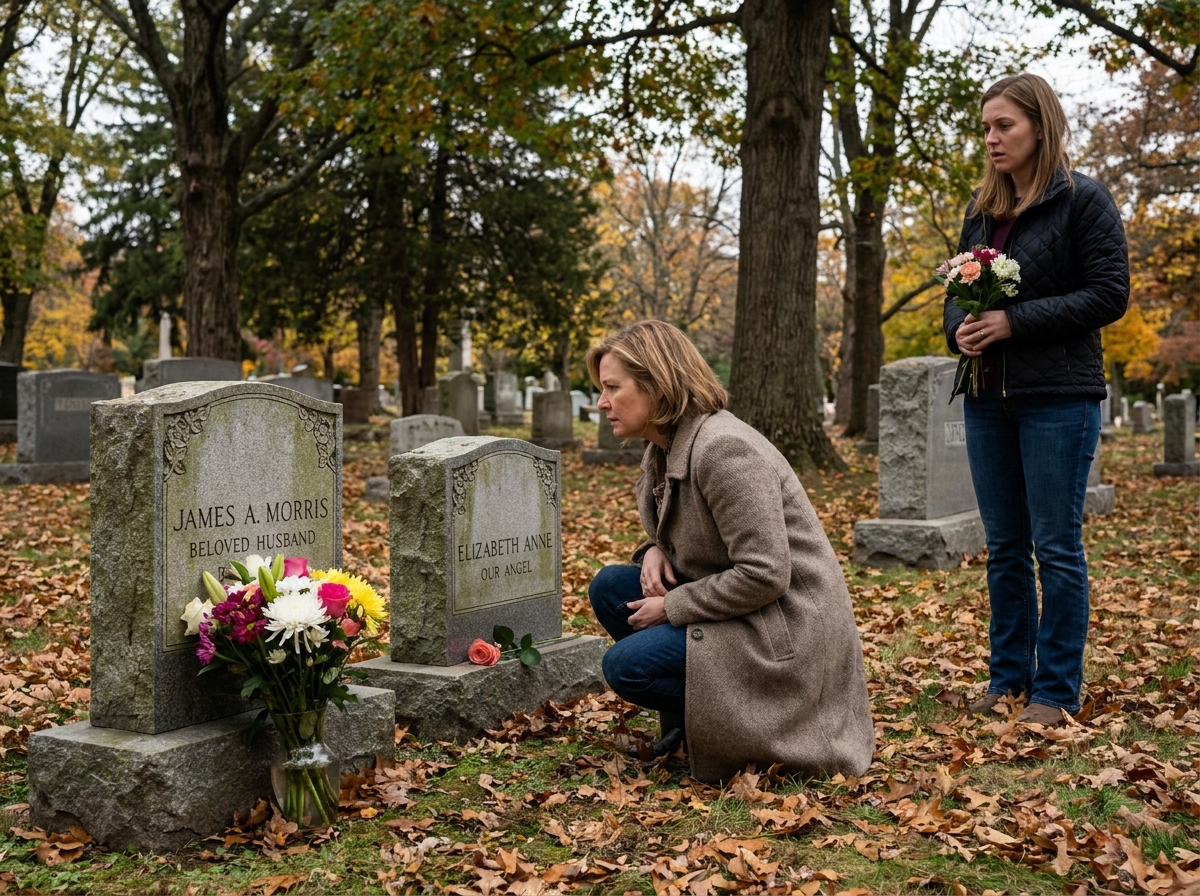
I parked at St. Anne’s. I walked to the maple tree. I was down on one knee clearing the leaves when her shadow fell over me.
“Whose grave is this, Mom?” Her arms were crossed. Her chin was shaking, and she meant it to look like anger. “Who is buried here? What have you been hiding? Dad is barely gone and you are out here every week. He would be ashamed of you.”
I looked up at my little girl, fifty-one years old, accusing her mother in a cemetery, and I felt no anger. She had half the story. Half a story is a poison.
“Read the stone,” I said.
She read it out loud, the way people do when a thing will not go into their head. “Daniel Ross. Beloved son.” “1978 to 2004.” She looked at me. “He was twenty-six. Who is Daniel Ross?”
“Sit down, honey.”
“Mom, who is Daniel Ross?”
“You remember March of 2004,” I said. “You were pregnant with Katie. Your father collapsed in the garage. You remember the ambulance.”
“Of course I remember. His heart. And then he got better. They fixed it.”
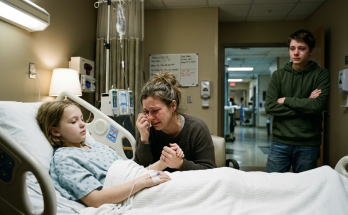
“They did not fix it, sweetheart.” I patted the grass beside me until she sat. “There was no fixing that heart. It was finished. The doctors told me on a Tuesday that your father had days. Maybe hours. I sat in that hallway all night, and I prayed the worst prayer a woman can pray, because for your father to live, somewhere out there, somebody’s child had to…”
I could not finish that sentence. Twenty-two years later, I still cannot.
“On the Thursday night, the call came. There had been an accident on the interstate. A young man. And by Friday morning, your father had a new heart beating in his chest, and somewhere in Ohio, a mother I had never met was planning a funeral instead of a wedding, because Daniel was engaged, Diane. He was twenty-six and engaged.”
Diane’s hand came up over her mouth. The wind moved the maple.
“Every Sunday for twenty years, your father stood right where you are standing. Rain, snow, Super Bowl Sunday. He said a man should thank the boy who is doing his living for him. And every Christmas he wrote a letter to Daniel’s mother, and every Christmas she wrote back. She only ever asked us for one thing. One thing, in twenty years of letters.”
“What did she ask?” Diane whispered.
I took the last yellow rose out of the paper, and I laid it on Daniel’s stone, and I told her.
“She asked that when your father’s time finally came, somebody would be here to remember Daniel, too. Because after forty-one years with your dad, I knew his heart inside and out. It was a good heart. A grateful heart. And your father kept his promise for twenty years, and when they lowered him into the dirt over at the other cemetery, I made sure the promise did not stop.”
Diane sat motionless for a long moment, staring down at the carved letters on the stone as if she were trying to fit twenty years of hidden history into the space of a single breath. The wind rustled the high branches of the maple tree, scattering a few dry seeds into the grass around our feet. She reached out and touched the edge of the granite marker with the tips of her fingers, her hand no longer trembling the way it had when she first stepped out from behind the trunk.
“Does Thomas know anything about this?” she asked, her voice dropping into a register so quiet I had to lean closer to catch the words over the distant sound of traffic.
“Your brother doesn’t know either,” I said, keeping my hands folded in my lap. “Your father wanted it kept between us. He said gratitude shouldn’t be loud. He said it was enough just to live the days that someone else had lost.”
“Twenty years,” Diane repeated, shaking her head slowly from side to side. “Every single week without missing a single Sunday. And all this time, Thomas and I thought you were just driving out to run errands or visit old friends across town. We never even suspected.”
“We liked it that way,” I told her, looking out across the quiet rows of markers that stretched toward the back fence of the cemetery. “Your father was a proud man in his own quiet way. He didn’t want the Sundays to be a family duty or a burden for you children. He wanted them to be a personal accounting. He said when you borrow a life, you pay the interest yourself.”
Diane let out a long, ragged breath and wiped her cheek with the back of her sleeve, her shoulders finally losing the tight stiffness they had carried all the way across town from our house. “Dad should have told us,” she murmured, looking up at me with wet eyes. “We could have come with him. We could have helped share it.”
“He carried it for twenty years because it was his to carry,” I said, gently resting my hand over hers where it lay on the damp grass. “And I carried it after him because that was the bargain we made in that hospital room when the world was ending. Some promises aren’t meant to be shared with a crowd, Diane. They’re meant to be kept in the dark where nobody else can mess them up.”
She nodded slowly, her fingers tracing the carved lines of Daniel’s name one more time before she finally pulled her hand back and straightened her posture against the trunk of the maple. “Will you let me come next week?” she asked, and there was no edge left in her voice now, only a quiet, steady resolve that sounded so much like her father it made my chest ache with a sudden, sharp clarity. “You shouldn’t have to carry the flowers all by yourself anymore, Mom. Not now that we know.”
I looked down at the bright yellow roses against the gray stone, then over at my daughter’s face, where the anger had entirely given way to something like grace. I reached out and squeezed her hand, feeling the same stubborn strength in her grip that I had held onto in that hospital room twenty-two years ago, when the monitors were beeping and the nurses were running down the hall.
“Next week,” I said, “we’ll buy three bunches instead of two.”
We stayed there together under the maple tree for a long time as the afternoon sun began to dip behind the old stone chapel across the lane, neither of us speaking as the shadows lengthened across the grass. When we finally stood up to leave, Diane reached down and brushed a stray autumn leaf off Daniel’s stone, just as her father used to do every single week without fail. We walked back to the cars side by side in the quiet evening air, and for the first time since March, the road ahead of me didn’t feel quite so long to drive alone.