Seat 12A
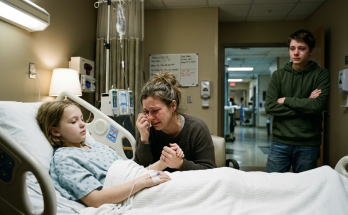
When our son Mike was diagnosed at seven years old, the pediatric oncologist sat across from my wife Claire and me in a small conference room and explained what was happening in the clear, careful language of someone who has learned that clarity is more merciful than softness. I remember thinking, in the middle of her explanation, that the room was very clean. I focused on that for a moment—the clean table, the clean chairs, the window with its view of the hospital’s inner courtyard. My mind needed somewhere to go.
Mike had a brain tumor. The treatment plan was aggressive. The outcomes were uncertain in the way that oncologists communicate uncertainty—with precision and without false comfort.
We drove home that afternoon without speaking much. We had left Mike with the nurses for an hour—he was already inpatient—and in that hour we had received information that divided our lives into before and after with the finality of a door closing. Claire held my hand across the center console. At one point she said, “Okay.” Not as an acceptance. As a gathering. As in: okay, we know what it is, now we deal with it.
That was eight months before the Make-A-Wish flight.
Eight months of hospital rooms and treatment schedules and the particular vocabulary that becomes your native language when your child is ill—dosages, markers, scan results, the meaning of various numbers in various ranges. Mike had been remarkably himself through most of it. He complained when he was uncomfortable and asked questions when he was curious and made jokes when the nurses expected nothing. He had a sense of humor that both delighted and undid me—the kind of humor that arrives in children who have understood something about the value of laughter without being able to articulate the understanding.
He was eight years old. He had a gap in his front teeth that he was very aware of and had opinions about. He liked soccer, though he had not been able to play in months. He liked drawing, which he could still do, and had covered the walls of his hospital room with pictures of things he planned to do when he was better.
Among the things he planned to do: Disneyland.
The Make-A-Wish volunteer’s name was Janet. She was a woman in her sixties with the specific warmth of someone who does not perform warmth but has genuinely arrived at it through years of choosing it. She sat beside Mike’s bed on a Tuesday afternoon while he was receiving treatment and asked him what his biggest dream was.
He did not hesitate.
“I’ve always wanted to go to Disneyland,” he said.
He said it with the certainty of someone stating a fact about themselves rather than a wish—this is who I am, someone who wants to go to Disneyland. He had always wanted this. It had been a feature of his wishlist since he was old enough to know what Disneyland was, which was approximately forever from his perspective.
Janet wrote it down.
One month later, we were at the airport.
I am not going to pretend I was calm at the airport. Claire had done better—she had the particular gift of finding the present moment when she needs it, setting aside what is past and what is uncertain in order to be fully in what is happening. I was trying. Mike made it easier. He had a rolling suitcase with a dinosaur print that he had chosen himself and that he pulled with the careful pride of someone managing important luggage. He asked three questions before we reached security. He asked four more in the security line.
When we boarded and he found his seat—12A, window—he pressed his face against the glass immediately.
He waved at the ground crew.
One of them saw him and waved back, which Mike reported to us as a significant event.
Claire reached over and took my hand. We sat in that for a while. Not speaking. Just present.
Mike was asking the flight attendant how the tray tables worked.
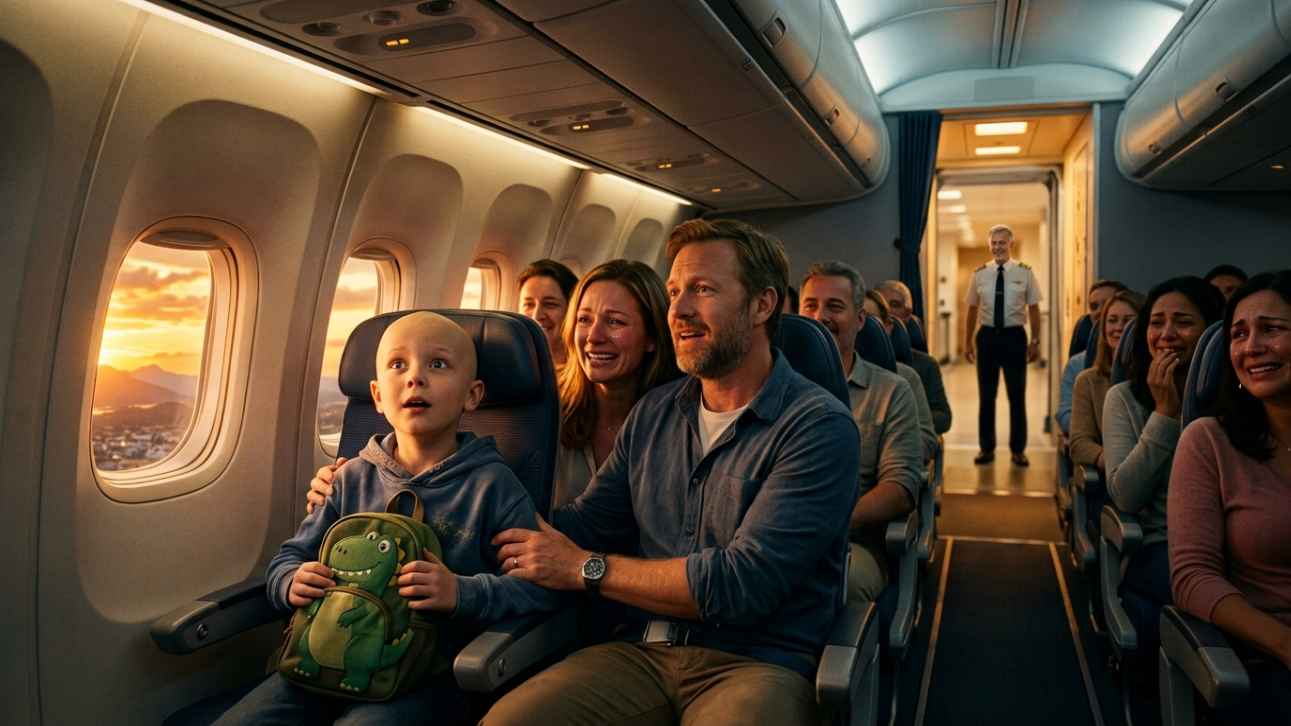
We were somewhere over Nevada, I think, when the captain’s voice came over the speakers.
I was mostly paying attention—I had learned, in eight months of living at a heightened level of alertness, to maintain a certain readiness even in moments that appeared safe. This is what sustained anxiety does to you. You are always partly somewhere else, monitoring.
The captain said Mike’s name.
The cabin went quiet in the way that cabins go quiet when something unexpected has happened—not a frightened silence, but a listening one. The kind that says: we are all paying attention to the same thing.
Mike looked around. His expression was the expression he got when something was happening that he hadn’t anticipated—a mixture of excitement and the slight wariness of a child who has learned that unexpected things can go either way.
“Seat 12A,” the captain said. “I hope you’re enjoying the trip so far.”
Mike said, to no one specifically, “He knows my seat.”
“But before we land,” the captain continued, “there’s one thing about this trip that you and your parents know nothing about.”
I looked at Claire. She looked at me. Neither of us knew what was coming. The Make-A-Wish coordinator had been thorough in her preparation—we had gone over every detail of the trip. We knew the hotel, the park plans, the accommodations that had been made. We had not been told about this.
The cabin was still listening.
“Mike,” the captain said, “we’ve been flying together for about ninety minutes. What you don’t know is that in approximately—” a pause, what sounded like a checked calculation, “—forty minutes, we’re going to make a brief stop.”
Mike leaned forward as though this would help him hear better.
“This stop is going to last about twenty minutes,” the captain said. “And when we land there, there’s someone who’s been waiting a long time to say hello to you.”
Mike looked at me.
I shook my head to indicate that I did not know what this meant. This was true. I genuinely did not know.
“The person waiting,” the captain said, “asked me to tell you one thing before we get there. He said to tell Mike that he’s heard a lot about him. And that he’s looking forward to finally meeting the boy who never stopped smiling.”
The captain paused.
“We’ll see you on the ground soon, Mike. Enjoy the rest of the flight.”
The speakers clicked off.
The cabin—which I now noticed had been quieter than usual for some time, with a quality of attention that, in retrospect, suggested the other passengers had been informed or had figured it out—broke into applause.
Not the polite applause of a group performing warmth. The genuine kind. The kind that comes when people are moved and have no other available outlet.
Mike looked at the people around him.
He looked at me.
He looked at Claire.
“Who’s waiting?” he said.
“I don’t know,” I said, which was the truth, and which was also the first time in eight months that not knowing something felt like the beginning of something good rather than something to brace for.
The stop was a small regional airport. Not our destination—we were still going to Disneyland, the captain confirmed when he made a brief additional announcement. This was a detour. A planned detour that everyone on the plane had apparently known about except for Mike and Claire and me.
When the plane taxied to a gate and the door opened, a flight attendant—Maya, who had been the one answering Mike’s questions about tray tables and oxygen masks and how the wheels worked—crouched beside his seat.
“Ready to meet someone?” she said.
Mike looked at her with the specific intensity of a child who has been waiting for information and is about to receive it.
“Who is it?” he said.
“Come find out,” she said.
She walked him up the aisle. Claire and I followed. The other passengers remained seated but watched—many of them, I noticed, with expressions that communicated they had been holding this moment and were glad it was arriving.
The jetway was ordinary. The terminal door opened.
Standing in the terminal, in a pilot’s uniform with a slight smile that suggested he had been looking forward to this moment for some time, was a man I recognized.
Mike saw him a fraction of a second after I did.
My son stopped walking.
The man waiting was a former professional soccer player who had retired three years earlier after a career that had included, among other things, a period with the national team during the World Cup cycle that Mike had watched with the complete devotion of a seven-year-old who has found his person. This player had been Mike’s—there is no other word—his person. The poster above Mike’s hospital bed. The name on the jersey Claire had brought to the first week of inpatient. The subject of approximately forty percent of Mike’s drawings.
He was standing in a small regional airport in Nevada in a pilot’s uniform because, as we learned in the minutes that followed, he held a private pilot’s license and had been one of the people in contact with Make-A-Wish for the past three weeks, coordinating the specific shape of this stop.
Mike said his name. Just the name. Quietly, the way you say something you cannot quite believe you are saying.
The man—his name was Marco; that is what I will call him because this story is Mike’s and I am mindful of that—Marco walked forward and crouched down to Mike’s level and said:
“I heard you never stop smiling. I’ve been wanting to check if that’s true.”
Mike was not smiling at this moment. He was doing something more profound than smiling—he was in a state of pure overwhelm, the kind that precedes all the other states and that in children looks like stillness, which is its own language.
“Is it true?” Marco said.
Mike looked at him.
Then Mike smiled.
“Usually,” Mike said.
Marco laughed. “I figured,” he said.
They shook hands. Mike had been practicing his handshake—the nurses had told him a firm handshake was important for life, a piece of advice he had taken with great seriousness. He delivered it. Marco received it with appropriate gravity.
“I hear you play soccer,” Marco said.
“I used to,” Mike said. “I haven’t been able to lately.”
“That’s temporary,” Marco said. “I’ve been temporary plenty of times. You come back.”
Mike looked at him.
“How do you know?” Mike said.
“Because you practice when you can’t play,” Marco said. “You watch. You learn. And then when your body is ready, all that practice is waiting for you.” He put his hand on Mike’s shoulder. “You’ve been practicing, right? In here?” He tapped his own head.
“Kind of,” Mike said. “I watch a lot of games.”
“That counts,” Marco said. “Every minute of that counts.”
Claire was beside me. She had her hand over her mouth.
We had twenty minutes.
Marco had arranged, in the small airport’s private lounge, a space that had been set up with two soccer goals—small, portable—and a foam ball. For fifteen of the twenty minutes, he and Mike played soccer in an airport lounge in Nevada while Claire and I watched from the edge of the room and could not speak.
Mike could not run the way he used to. His stamina was reduced. He tired more quickly than he would have before. He knew this about himself—he had made his peace with it in the specific way children make peace with things, which is usually more complete than adults manage.
Marco matched his pace without making a performance of it. He played at the level Mike could play at, with the naturalness of someone who has spent time around children and understands that condescension is the one thing you must never offer. He celebrated Mike’s goals with the genuine enthusiasm of someone who means it. He complained elaborately about his own misses, which made Mike laugh.
For fifteen minutes, Mike was an eight-year-old playing soccer.
Not a patient. Not a diagnosis. Not a child focused on appointments and treatments and the machinery of illness. A boy playing soccer with someone he had admired from a distance for a year, who had come to an airport in Nevada to play a foam-ball game in a lounge because someone had asked and he had said yes.
At one point, during a brief break while Mike was catching his breath, Marco came to stand beside me.
“He’s good,” he said.
“He was better before,” I said.
“He’ll be better again,” Marco said.
I looked at him.
“You can’t know that,” I said.
“No,” he said. “But I know he plays like someone who intends to.”
I did not have a response to that.
Before we reboarded, Marco and Mike sat together for a few minutes. I do not know everything they said—I was standing with Claire at enough of a distance to give them some privacy, because whatever was being said was theirs. I could see Mike’s face. I could see that he was talking with the seriousness he brought to things that mattered to him. Marco was listening with the same quality of attention.
At some point, Mike showed Marco a drawing he had in his backpack. He always had his drawing things—it was the one constant. Marco looked at the drawing and said something that made Mike sit up straight with the pride of someone whose work has been seen correctly.
Marco signed the drawing.
He signed a second piece of paper and folded it and gave it to Mike and told him to open it when he was having a hard day. Not to open it now. For a hard day.
Mike put it in the small front pocket of his backpack where he kept things he considered important.
“Deal?” Marco said.
“Deal,” Mike said.
They shook hands again. Mike delivered the handshake.
Marco walked us back to the jetway.
He crouched down to Mike’s level one more time.
“I’m going to ask Make-A-Wish to keep me updated,” he said. “If that’s all right with you.”
Mike looked at him.
“You want updates?” Mike said.
“I want to know how the comeback goes,” Marco said. “I’m serious about this. I want to know when you get back on a real field.”
Mike thought about this.
“Okay,” he said.
“Good,” Marco said. “Now go to Disneyland. Report back on everything. I need details.”
“About what?”
“About whether Space Mountain is as good as everyone says,” Marco said. “I have strong opinions. I need data.”
“What’s your opinion?” Mike said.
“I’m not telling you before you go,” Marco said. “That would bias the data.”
Mike nodded with the seriousness of someone who understands the scientific method and appreciates its application. “Good point,” he said.
We reboarded.
Mike was in his seat at 12A again, face to the window as the plane pushed back. He was quiet for the first several minutes of the taxi, which was unusual for him. I watched him from the seat beside him—Claire was across the aisle—and let the quiet be.
Eventually he turned to look at me.
“Dad,” he said.
“Yeah, buddy.”
“Did you know he was going to be there?”
“No,” I said.
“Did Mom?”
“No.”
He turned back to the window.
“How did they know to call him?” he said.
“I think someone at Make-A-Wish reached out to him,” I said. “And he said yes.”
Mike was quiet.
“He didn’t have to do that,” Mike said.
“No,” I said. “He didn’t.”
“But he did.”
“He did.”
Mike looked at the window. We were lifting off now, Nevada tilting away below us, the landscape opening into the broad geometry of the west.
“He wants updates,” Mike said.
“I heard.”
“About the comeback.”
“Yes.”
Mike was quiet again.
Then: “I’m going to have a comeback,” he said. Not a wish. A statement.
“I know,” I said.
“He thinks so too,” Mike said.
“He does.”
Mike pressed his face against the glass. Below us, the airport had become small. In the terminal somewhere, Marco was presumably going wherever he was going, back to his own day, his own life, having spent twenty minutes playing foam soccer with an eight-year-old in a pilot’s uniform for reasons that had nothing to do with obligation and everything to do with someone asking and him deciding to say yes.
“Dad,” Mike said.
“Yeah.”
“Space Mountain is definitely good,” he said. “I can already tell.”
“You don’t know yet,” I said.
“I know,” he said. “I can tell.”
He was right. It was good. He rode it four times.
The letter in the small front pocket stayed there for two weeks.
I knew it was there because Mike told me he had not opened it yet, as updates on the letter’s status. He was saving it. This was characteristic of him—he had an instinct for the right moment.
He opened it on the second day after we got home, on a morning that had been difficult. Treatment days were hard, and this was a treatment day, and Mike had come down to breakfast quieter than usual, in the specific way of someone who is gathering themselves for something they don’t want to do.
He sat at the kitchen table and looked at the window for a while.
Then he went to his backpack and came back with the folded paper and opened it.
I was at the stove, pretending to be more occupied with breakfast than I was.
I did not read the letter—it was his. But I watched his face while he read it.
He read it twice.
Then he folded it carefully along the same lines and put it back in his pocket and sat for a moment.
“Ready?” Claire said. She was at the table with her coffee.
“Yeah,” Mike said.
He ate his breakfast.
He did not tell us what the letter said, and we did not ask. Some things are private in a way that deserves protecting, and this was his. I hope he still has it.
The update Marco asked for came fourteen months later.
It came in the form of a photograph that Make-A-Wish helped us pass along—Mike on a soccer field, in his jersey, at the start of a practice. Not a game yet. A practice. The beginning of the comeback.
He was smiling.
The gap in his front teeth had been joined by his adult teeth by then, which had changed his smile in the specific way that happens between eight and nine, the change that makes children look slightly more like the people they’re becoming.
He looked, in the photograph, like a boy who was going somewhere.
I did not see Marco’s response, but the Make-A-Wish coordinator told us he had written back immediately and that the response included something she described as “very enthusiastic” and “possibly also some data about Space Mountain.”
Mike, when told about the response, was very pleased.
“I told him,” he said.
“Told him what?” Claire said.
“That it was good,” Mike said. “The data was clear.”
I tell this story when people ask about the trip, which they do because it is the kind of thing people sense is a story worth asking for. And I tell it in full, the way I have told it here, because the full version is the one that matters—not just the moment in the airport lounge, but the moment on the porch when Mike got his suitcase ready, and the moment Claire took my hand on the plane, and the moment the captain said Mike’s name and the cabin went quiet.
All of it is the story.
The story is about an eight-year-old who never stopped smiling.
The story is about the people who saw that—really saw it—and responded to it.
The story is about the pilot who made an announcement. The volunteers who planned three weeks of logistics so that a boy and his hero could play foam soccer in an airport lounge for fifteen minutes. The man who put on a pilot’s uniform and flew to Nevada because someone asked and he said yes.
The story is about what people can do when they decide to show up.
My son is showing up.
He has always been showing up.
The comeback is ongoing.
THE END