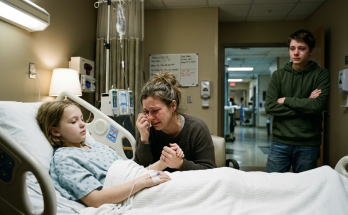
The Pen and the Gate
My hand shook just enough to make the ink smear across the last line of the agreement. The pen’s tip clicked against the paper, a tiny, stubborn sound that seemed louder than the ticking clock on the wall. The room smelled faintly of stale coffee and the antiseptic clean of the mediator’s office, a smell that had followed me through three different apartments in the last year.
Ethan Cole was sitting across from me, his shoulders rigid, his jaw set like he’d been bracing for a punch that never landed. The documents lay between us, a thin barrier of legalese that felt more like a thin sheet of ice. I could hear the soft whirr of the air conditioner, the low hum of the building outside, the distant wail of a siren that seemed to echo the urgency inside my chest.
When I finally set the pen down, the sound of the metal click reverberated through the room. The clock on the wall struck ten minutes past three, the second hand pausing for a heartbeat before moving again. My eyes flicked to the tiny digital display on my phone. 10:03 a.m. exactly.
That was the moment I’d imagined a thousand times in the dark of my bedroom, the way the sheets would cling to my skin, the way my throat would tighten and I’d feel the weight of the world settle on my shoulders. I imagined tears, a scream, a collapse into the floorboards. I imagined anger that would flare like a match, and maybe, just maybe, a sliver of regret that would gnaw at me long after the papers were signed.
But the silence that fell after the pen hit the final line was not a scream. It was a quiet, empty stillness—the kind that follows something already broken beyond repair.
The Call
Ethan’s phone buzzed on the polished wood of the table. The ringtone was that cheap, tinny tune he’d used for years—a little melody that never rang for business, only for personal calls. He didn’t look up. He let the sound fill the room, a low vibration that seemed to echo off the walls.
He pressed the green button, and his voice came out casual, almost bored.
“Yeah.”
A pause, then his tone softened in a way I hadn’t heard in years, the kind of softness that used to be reserved for bedtime stories and late‑night apologies.
“It’s done.”
He didn’t move, didn’t even glance at the papers. The mediator slid the stack toward him, the glossy pages catching the light. Ethan’s fingers hovered for a second, then he tossed the pen aside, the metal clattering onto the hardwood floor.
He didn’t read a single word.
“The condo is mine. The car too,”
he said flatly, as if reciting a grocery list.
“And the kids? If she wants them, she can have them.”
His voice was steady, a monotone that made the words feel like they were being spoken by someone else entirely.
My chest tightened. Not in the way it used to—tightening into a knot that threatened to choke me—but in a way that felt like a muscle finally releasing after years of strain. I wasn’t broken. I was empty, a hollowed-out shell that had learned to survive without the weight of his expectations.
Lauren, his sister, leaned against the wall behind her, arms crossed, eyes glittering with a satisfaction that made my skin prickle. She’d always been the one who could read Ethan like an open book, and today she seemed to be reading a new chapter entirely.
“Finally,”
she said, her voice low, a hint of triumph in it.
“My brother gets the future he deserves. A woman who can actually give this family a son.”
Her eyes flicked to me, and in that glance I saw contempt, a disdain that seemed to say I was an obstacle, a relic of a past that no longer mattered.
Her words landed, but they didn’t hurt. I’d stopped expecting anything better, any kind of validation from a family that had always seen me as an afterthought.
I placed a set of keys on the table without a word. The metallic clink seemed louder than the rest of the room.
“We moved out yesterday.”
Ethan smirked, a small, crooked smile that didn’t reach his eyes.
“Smart decision.”
Then I pulled out two navy‑blue passports, the glossy covers catching the light. I slid them next to the keys, the paper crisp under my fingertips.
“I’m taking Aiden and Chloe to London,”
I said, my voice calm, a quiet certainty that surprised even me.
“We’re leaving today.”
He stared at the passports, his eyebrows rising just enough to suggest curiosity, then confusion.
“What?”
Lauren let out a short, sharp laugh.
“With what money? You can’t even—”
I didn’t answer. The words hung in the air, unfinished, as if the room itself had decided it didn’t need to hear the rest.
Five minutes later, the doors to the office swung open. I walked out with Aiden, ten, his backpack slung over his shoulder, and Chloe, six, clutching a worn‑out stuffed rabbit that had seen more bedtime stories than any of us could count. The hallway smelled of freshly waxed floors and the faint perfume of a woman who had just left a meeting. The receptionist gave me a polite smile, the kind that never reached her eyes.
We stepped into the bright afternoon, the sun slanting through the glass doors, casting long shadows across the pavement. The city buzzed around us—honking horns, distant chatter, the scent of roasted coffee beans drifting from a nearby café. I could hear the distant rumble of a subway train, a low vibration that seemed to echo the tremor in my own chest.
We didn’t look back. The building behind us, the gray concrete that had held the weight of my last five years, receded into the distance as we made our way to the car.
Across Town
Half an hour later, the private clinic on Willow Street was a hive of nervous anticipation. The waiting room was a soft, pastel‑colored space, the kind of place that tried to make you feel at ease with its gentle lighting and the faint hum of an aquarium in the corner. Seven people sat rigidly in the upholstered chairs, their eyes flicking from the glossy magazine on their laps to the door that led to the ultrasound room.
There was Ethan’s mother, a stern woman with hair pulled back into a tight bun, her hands clasped tightly around a porcelain cup of tea. His older brother, Mark, a man who always wore a watch that seemed to cost more than his entire wardrobe, shifted his weight impatiently. Lauren, leaning against the wall, arms still crossed, a faint smile playing on her lips as if she were waiting for a punchline.
Then there was the mistress—Jenna—her hair pulled into a messy bun, a thin scar on her left cheek that caught the light when she turned her head. She sat with a small, trembling hand resting on the edge of the chair, her eyes darting to the door every few seconds.
The doctor, a middle‑aged man with graying hair at the temples, entered the room with a tablet in hand. He wore a white coat that seemed too crisp for the warm air of the clinic, his shoes polished to a shine that reflected the fluorescent lights.
He cleared his throat, a soft sound that seemed to cut through the tension like a knife.
“Ladies and gentlemen,”
he began, his voice steady, professional.
“I have the results of the ultrasound.”
He glanced at the screen, his eyes flicking over the image of a tiny, beating heart. A soft murmur rose from the group, a mixture of curiosity and dread.
Then he looked up, his expression changing in a fraction of a second—a flicker that went unnoticed by most, but lingered in my memory like a photograph half‑forgotten.
“I’m sorry,”
he said, his tone softening.
“There appears to be a severe cardiac anomaly. The prognosis is poor.”
The room fell into a stunned silence. The hum of the aquarium seemed louder now, the bubbles rising in slow, deliberate arcs.
Ethan’s mother placed her cup down with a faint clink, her eyes wide, her mouth forming an “O” that never quite made sound. Mark’s jaw tightened, his watch flashing a quick glance at the time, as if trying to calculate the seconds that had just slipped away. Lauren’s smile faded, her eyes narrowing as she stared at the doctor, then at Jenna, then at the empty space where the baby’s future should have been.
Jenna’s hand trembled, the scar on her cheek catching the light as she pressed it against her thigh. She whispered, barely audible.
“No… no…”
The doctor’s words hung in the air, heavy and unyielding, a weight that settled on the shoulders of everyone present. The sound of the air conditioner seemed to grow louder, the soft whirring now a backdrop to the collective gasp that seemed to emanate from nowhere.
In that moment, the world felt paused, as if the very fabric of time had been stretched thin, holding a breath that no one could exhale.
The Flight
The airport was a blur of colors and sounds. The fluorescent lights above the check‑in counters buzzed, the intercom crackled with announcements in a dozen languages. I pushed the cart with our luggage, the wheels squeaking on the polished tile, as Aiden tried to keep his balance, his eyes glued to the moving conveyor belt of suitcases.
Chloe clutched my hand tightly, her small fingers digging into the skin of my palm. She whispered something about the clouds, about the “big fluffy things” that would be waiting for us in the sky. Her voice was soft, a gentle lilt that reminded me of the lullabies I used to sing to her before bedtime.
We passed through security, the metal detector beeping twice as my passport brushed against the scanner. The scent of disinfectant mixed with the faint aroma of coffee from a nearby kiosk, a comforting reminder that life continued to move forward, regardless of the chaos that had just unfolded.
At the gate, I watched the flight attendant—her hair pulled back into a neat bun, a name tag that read “Mia”—stand by the door, her smile practiced, her eyes scanning the crowd for any sign of distress.
The boarding call echoed through the terminal, a melodic chime that signaled the start of a new chapter. We stepped onto the jet, the metallic scent of the aircraft interior enveloping us, the low hum of the engines a steady thrum beneath our feet.
As the plane taxied down the runway, the world outside blurred into a wash of gray and green, the city lights flickering like distant fireflies. I settled into my seat, the seatbelt clicking into place, the small, soft fabric of the cushion cool against my skin.
Aiden stared out the window, his eyes following the receding landscape, his mind already racing through the possibilities of a new school, new friends. Chloe pressed her forehead against the glass, as if trying to imprint the memory of the clouds onto her skin.
For a moment, the plane’s engines roared to life, the vibrations shaking the seat, and I felt the familiar surge of adrenaline that had accompanied every major decision in my life. But this time, the surge was different—it was quiet, almost absent, a calm acceptance that settled like a stone in a pond.
The flight attendant walked down the aisle, offering drinks. I took a cup of water, the cool liquid sliding down my throat, a small comfort in the midst of uncertainty.
When the plane finally leveled off, the clouds stretched out like a soft, white ocean below us. I closed my eyes, letting the gentle hum of the engines lull me into a brief, meditative silence. The world outside was a blur, the city a distant memory, the divorce papers a distant echo.
Aftermath
We arrived in London late in the afternoon. The air was damp, a thin mist hanging over the city, the streets glistening under the soft glow of street lamps. The taxi driver, a middle‑aged man with a thick Irish accent, drove us through the winding streets, his hands steady on the wheel, the radio playing a soft indie track that seemed to match the rhythm of the rain.
Our hotel room was modest, a small space with a view of a narrow alley where a lone cat stalked the shadows. The bed was a twin‑size, the sheets crisp and white, the scent of fresh linen filling the room.
That night, after the kids fell asleep, I sat on the edge of the bed, my head resting on my hands. The city’s sounds filtered through the thin walls—the distant clatter of a bus, the soft murmur of a conversation in a nearby bar, the occasional siren that seemed far away.
I thought about the ultrasound, about Jenna’s trembling hand, about the doctor’s words. I thought about the seven faces that had been there, about the way Lauren’s smile had vanished, about the way Ethan’s mother’s hands had clenched around her tea. I thought about the pen that had struck the final line at 10:03 a.m., the exact moment the clock ticked once—clean, final.
There was a strange emptiness in all of it, a void that felt both terrifying and oddly liberating. The anger I had expected never arrived. The grief was a quiet, low hum that settled into the background like the low‑frequency rumble of the plane’s engines.
In the morning, I woke early, the sunlight spilling through the curtains, painting the room in soft gold. Aiden was already up, his small feet padding across the carpet, his voice bright as he announced his plan to explore the city.
“Mom, can we go to the museum? I want to see the dinosaur bones,” he said, his eyes sparkling with curiosity.
Chloe, still half‑asleep, mumbled something about a “big fluffy cloud” and clutched her stuffed rabbit tighter.
I smiled, a genuine smile that reached my eyes, and nodded.
“Sure, sweetheart. Let’s go.”
We stepped out onto the rain‑slick streets, the city alive with the chatter of commuters, the clatter of umbrellas, the smell of damp pavement mixed with fresh coffee. The world felt new, uncharted, a blank page waiting for us to write our story.
The Echo
Weeks turned into months. The children settled into a new school, Aiden making friends over a shared love of video games, Chloe finding comfort in a small art class where she could draw the clouds she so often talked about. I found work at a local publishing house, my days filled with the soft rustle of pages, the faint scent of ink and paper.
One rainy evening, as I was sorting through a box of old photographs, I came across a picture I didn’t remember taking. It was a blurry shot of a hospital hallway, the fluorescent lights casting a harsh glow on the white walls. In the background, a woman stood, her back turned, a small, leather‑bound notebook clutched in her hand. The name “Natalie” was scribbled on the cover, the ink slightly smudged.
he said, a faint chuckle in the background. his voice sounded almost amused. her voice was soft, a distant echo from a childhood bedroom. I said, my voice barely above a whisper. “Did… did you ever know about a baby?” she said finally, a tremor in her voice. I whispered. “It was real.”