My father’s lawyer called me on a Wednesday morning while I stood in the hospital parking lot, absentmindedly pressing the lock button on my car key and wondering if I had actually locked the doors.
The call caught me off guard. Dad had been growing weaker for two years, so I knew this day would eventually come. Still, when the call announcing someone’s death finally arrives, it always feels as though you should have been doing something far more meaningful than standing in a parking lot checking your car.
I pressed the button one last time as the lawyer finished speaking.
His name was Gerald Marsh. Calm, compassionate, and experienced, he had the gentle voice of someone who had delivered difficult news many times before. He told me my father had died at 6:14 that morning. He explained that I had been named executor of the estate and that we needed to meet to discuss several important matters.
“What kind of matters?” I asked.
He paused briefly before answering. “Matters that will require your full attention, Ms. Calloway. When you are ready.”
We arranged to meet on Friday.
My name is Sophie Calloway. I was thirty-seven, working as a hospital administrator in a medium-sized Ohio city I’d moved to at twenty-four and never left. My father, Raymond Calloway, lived forty minutes away in the gray colonial home where I grew up, the one with the bright red front door and the creek behind it that had “eaten” my shoe when I was a little girl—or at least that was the story I insisted on telling.
My parents divorced when I was eleven. Mom remarried and relocated to Phoenix. Dad stayed exactly where he was. He spent the next thirty-two years living in that same house while working as a contractor, adding rooms and decks to other people’s homes while letting his own age comfortably around him.
I visited every few weeks. We’d have dinner, watch baseball, and argue over things that didn’t really matter. When the conversations became serious, we usually managed to understand each other before the evening ended. Dad wasn’t someone who spoke openly about emotions, but he was always there when it counted, and that mattered more to me than words.
I also had two half-siblings from one of Dad’s later relationships. He never married their mother, Karen, but they remained close for years. Derek was twenty-eight, working for a logistics company in Columbus. Amber was twenty-six, finishing graduate school in education while sharing a house with roommates.
We got along well enough. We hadn’t grown up together, so we were never especially close, but we were friendly whenever family gatherings brought us together. As Dad’s health declined, we spent more time together in hospital waiting rooms, each loving him in our own way.
Gerald Marsh’s office was downtown inside an older building with polished brass fixtures and the unmistakable atmosphere of a law office. He greeted me warmly before placing a folder on his desk.
“Before we begin,” he said, “I want to tell you that your father spoke about you frequently. He was proud of you in the specific way of a person who doesn’t always find the words for pride but never stops feeling it.”
I stared at the folder.
“Thank you,” I said quietly.
He opened it.
Dad’s estate was modest. The house was valued at about $340,000. There was a savings account, a small investment portfolio, his truck, personal belongings, and the contracting tools he’d retired two years earlier.
The will divided the house equally among the three of us. His financial accounts, however, were left entirely to me, with a note explaining it was in recognition of the years I’d spent caring for him through his illness. The remaining belongings would be divided by mutual agreement, with any disagreements handled through a legal process Gerald explained in more detail than I could absorb that day.
“The house is the significant issue,” Gerald said.
“Why?”
He folded his hands together.
“Because equal shares mean all three of you must agree on what to do with it. You can sell it and divide the proceeds. One sibling can buy out the others. You can rent it and split the income. But none of those options can proceed without consensus.”
“And if we can’t agree?”
“Then eventually a court can compel a partition sale,” he said. “But that process is slow, expensive, and tends to produce outcomes nobody finds satisfying.”
I looked back at the folder.
“Do Derek and Amber know about this structure?” I asked.
“They have been notified of the basic terms,” he replied. “I believe they may be calling you.”
Driving home that October afternoon, I kept glancing at the folder on the passenger seat, feeling the weight of responsibility settle deeper with every mile.
Derek called before I reached my apartment.
His voice was careful and sympathetic. He offered his condolences, asked how I was doing, then gradually shifted toward the estate. He said the process seemed straightforward and that he hoped we’d work through everything together.
Then he suggested we sell the house as quickly as possible.
“The market is good right now,” he said. “And honestly, splitting the proceeds three ways would be meaningful for all of us.”
“It would be meaningful for me too,” I replied. “But I want to take some time to think about it.”
“Of course,” he said. “Absolutely. No rush.”
The silence afterward suggested he believed there was.
Amber texted instead of calling, exactly as I’d expected. She said she was thinking of me, hoped we could discuss the next steps soon, added a heart emoji, then followed it with a message mentioning that she’d been looking at the housing market and that it seemed like a favorable time to sell.
I appreciated the heart emoji, even if it was immediately followed by market research.
That evening I answered neither of them.
Instead, I sat in my apartment with a bowl of leftover soup and the folder from Gerald, thinking about the gray colonial, the red front door, and the little creek that had supposedly swallowed my shoe.
Eventually, I got in my car and drove to the house.
I still had my key because I’d been managing Dad’s affairs during his illness. It slipped into the lock as easily as always, though somehow I hadn’t been certain it would. I stood quietly inside the dark entryway before reaching for the light switch.
The house still smelled like him—wood, sawdust, overly strong coffee, and the familiar scent of a home lived in comfortably by one person who cared more about living there than updating it.
I switched on the lights and slowly walked through every room.
Not to inspect anything.
Just to be there.
The kitchen still had the rooster-patterned tiles my grandmother had chosen decades earlier, tiles Dad had never bothered replacing because he liked them. The living room still held his armchair angled perfectly for his aching hip. In the basement, every tool remained neatly outlined on the pegboard exactly where it belonged.
His bedroom was untouched.
His reading glasses rested on the nightstand.
A library book was three weeks overdue.
His robe still hung behind the bedroom door.
I sat on the edge of his bed and looked at it.
Dad had always shown up.
When I needed appendix surgery, he’d driven forty minutes to sit beside me even after I insisted it was only a minor operation. He helped me move twice. After one painful breakup, he simply sat across from me at the kitchen table and listened without offering advice. Every Tuesday evening for twelve years, he called because Tuesday was the day he always called, and I hadn’t realized how much comfort that routine gave me until it disappeared.
I sat there with those memories until the silence felt almost familiar.
Then I went home and finally slept.
The following morning, I called Gerald again.
I wanted to understand exactly what being executor allowed me to do. He patiently explained that my responsibility was to guide the probate process and keep everything moving fairly. I couldn’t decide the future of the house on my own, but I could establish a reasonable timeline and oversee the process.
“How much time do I have?” I asked.
“The estate doesn’t close overnight,” he said. “A few months of thoughtful consideration is entirely reasonable.”
“And if Derek and Amber press for a faster timeline?”
“They can press,” Gerald said. “The executor manages the pace.”
I thanked him.
Over the next two weeks, I buried myself in paperwork. I contacted banks, utility companies, insurance providers, and every institution that needed notification. Organizing those practical details gave me something concrete to focus on while grieving.
The memorial service drew far more people than I expected. My father had spent thirty years building homes throughout the town, and many of the families he’d worked for came to pay their respects, sharing stories I’d never heard before.
Derek and Amber stood beside me throughout the service. We were kind to one another, balancing genuine grief with the reality that we also shared an inheritance.
Twice during the reception, Derek mentioned the house. The second time, Amber quietly touched his arm, and he stopped speaking.
That told me enough.
So I invited both of them to meet the following Saturday at Dad’s house.
It felt like the only place where that conversation truly belonged.
The following Saturday, Derek showed up first. He brought his girlfriend, Maya, explaining she was there for support. She hadn’t been invited, but I didn’t object. About twenty minutes later Amber arrived carrying a homemade coffee cake. It was a thoughtful gesture, even if eating cake while discussing the future of our father’s estate felt strangely out of place.
I had spent the week preparing.
Not because I’d already made my decision, but because I wanted us to understand every realistic option before making one.
“I want us to make a good decision,” I told them. “And I think a good decision requires more information than we currently have.”
Derek shrugged.
“The information seems pretty simple. The house is worth around three hundred and forty thousand dollars. Split three ways, that’s more than a hundred thousand each.”
“It is significant,” I agreed. “But before we decide to sell, I want us to consider every option.”
Amber nodded with interest.
Derek remained cautious.
During the previous week, I’d met with a property manager, spoken to a rental market specialist, reviewed comparable listings in Dad’s neighborhood, and even consulted two additional estate attorneys—not because I doubted Gerald, but because I wanted a complete picture.
Then I laid everything out.
If we rented the house, current market rates suggested it could bring in about $2,200 each month. After management fees, taxes, and maintenance costs, the net income would be roughly $1,700. Split three ways, each of us would receive just under $570 a month, or close to $6,800 annually.
“Over ten years,” I explained, “that is sixty-eight thousand dollars each in passive income. The house would likely appreciate during that period, meaning the eventual sale price would be higher than today’s valuation.”
Derek frowned.
“That assumes everything goes smoothly.”
“It assumes normal market conditions and reasonable management,” I replied. “Which is not guaranteed, but it is the historical pattern for this neighborhood.”
“What if one of us needs the money before ten years?” Amber asked.
It wasn’t an argument. It was a fair question.
“Then we revisit the decision,” I said. “We can always sell later if circumstances change. Renting doesn’t lock us in forever.”
“It’s complicated,” Derek muttered.
“Most good decisions are.”
Maya finally spoke.
She thought the rental idea sounded sensible.
Derek shot her a quick glance before looking back at me.
Then I introduced the option that mattered most to me.
I wanted to buy them both out.
I hadn’t guessed at the numbers. I’d spoken with my bank, met with a mortgage broker, reviewed my savings, checked my credit, and calculated exactly what I could afford.
It wouldn’t be easy.
But it was possible.
“You want to keep it,” Amber said.
“I want to keep it.”
Derek slowly looked around the kitchen.
His eyes paused on the rooster tiles, then drifted toward the basement door where part of Dad’s workshop was visible.
“Why?”
There wasn’t any hostility in his voice.
He genuinely wanted to know.
I had already thought about my answer.
“Because it holds thirty-two years of who he was,” I said. “Because his workshop is in the basement and his tools are on the pegboard and the tiles are the ones his mother picked. Because I drove here in the middle of the night six weeks ago and sat on the edge of his bed and knew I was not ready for this to be someone else’s house.”
Silence settled over the kitchen.
“I’m not asking either of you to feel the same way,” I continued. “I know this house means something different to each of us. I just want you to understand what it means to me before we sell it simply because it’s the fastest solution.”
Amber studied me for several moments.
“What would you pay us?”
“Fair market value for your shares,” I answered. “One hundred and thirteen thousand each. I will have it appraised independently so neither of you is taking my word for the valuation.”
Derek leaned back.
“Where are you getting the money?”
“A combination of refinancing and savings. I’ve already spoken with a lender.”
“You’ve already talked to a lender?”
“I wanted to know whether it was possible before I brought it to you. I didn’t want to make promises I couldn’t keep.”
He exchanged a glance with Maya.
Maya looked down at the untouched coffee cake.
“I need time to think about it,” Derek finally said.
“Of course. I’m not asking for an answer today.”
Amber agreed she also wanted time.
Her voice sounded warmer than before, though I reminded myself that kindness and agreement weren’t necessarily the same thing.
They left shortly after two.
I stayed behind.
Sitting in Dad’s armchair, positioned at the exact angle that eased his bad hip, I looked around the quiet living room and wondered whether I was truly ready to take on everything that came with keeping this place.
For Derek and Amber, the house had never carried the same memories. They hadn’t grown up here. The creek wasn’t part of their childhood. The rooster tiles were simply old kitchen tiles.
There was nothing wrong with that.
They had known our father differently than I had.
I wasn’t offering to buy their shares because they were wrong to want the money.
I was offering because, for me, the money had never been the most important part.
That was my choice.
And it was equally their right to judge my offer however they wished.
Two weeks passed.
During that time Derek called once with a few questions about the financing. I answered every one directly.
Amber texted me twice.
Neither message mentioned the house.
That alone told me she was still thinking.
Then Derek called again.
He said he’d spent time considering everything and had also spoken with a financial advisor.
In the end, he admitted the truth.
He needed the money now more than he needed future rental income or the emotional value the house held for me.
“I want to accept your offer,” he said.
“Okay,” I replied. “Thank you for thinking about it carefully.”
“Sophie…”
He hesitated.
“I know this place meant something different to you. I’m glad you told us that.”
I held the phone quietly.
“He was proud of you,” I said. “He told me.”
There was a long pause.
“He told me too,” Derek answered softly. “About you.”
For a moment, neither of us spoke.
We simply shared the silence left behind by a father who had always found his own way of showing up for each of us.
Amber called the very next day.
She told me she’d spoken with Derek, consulted a friend who worked as a financial planner, and spent time thinking about what I’d said—that the house held thirty-two years of our father’s life.
“I want to accept your offer too,” she said. “But I want one thing.”
“Tell me.”
“The reading glasses on his nightstand,” she said. “And the photo on the bookshelf. The one of all three of us at his sixtieth birthday.”
“Of course,” I answered without hesitation.
She was quiet for a moment before asking one more question.
“And can I come back sometime? When I need to?”
“This will be your family’s house too,” I told her. “Whenever you want.”
She cried a little then.
So did I.
Neither of us ended the call right away.
The paperwork was finalized on a Thursday in January. It wasn’t an especially memorable month, but everything was finally ready. I signed the documents in Gerald’s office, then drove straight to the gray colonial.
I sat in the driveway for several minutes before going inside.
The house belonged to me now.
I say that carefully, because it still belonged to my father in countless ways.
His workshop remained downstairs.
The rooster tiles still covered the kitchen walls.
The library book—now four months overdue—was still sitting where he’d left it because I’d renewed it online twice instead of returning it.
His armchair still faced the television at exactly the angle that eased his bad hip.
His robe still hung behind the bedroom door.
The house carried thirty-two years of a man who had always shown up for the people he loved.
Now it also carried the responsibility of becoming mine.
That transition didn’t happen overnight.
Throughout the winter, I spent nearly every Saturday there.
I didn’t renovate.
I didn’t modernize.
I simply lived in the space.
When spring arrived, I planted flowers near the creek after a neighbor suggested the spot would be perfect. I also repaired the loose gutter above the front porch—a problem Dad had ignored for years by simply avoiding that section whenever it rained.
That solution had been very much like him.
Little by little, I moved some belongings from my apartment.
Not everything.
The house didn’t need to become an extension of my apartment.
It needed time to become itself again—with me living inside it.
In April, Derek and Maya came for Sunday dinner.
I cooked Dad’s famous chili using the handwritten recipe card I’d found in a kitchen drawer. The instructions were wonderfully vague, measuring ingredients with phrases like enough and a good bit, forcing me to guess more than once.
Apparently, I guessed correctly.
Derek had two bowls.
“It tastes like I remember,” he said.
I couldn’t have received a better compliment.
Amber visited in May with two friends who knew nothing about the house’s history. They sat on the back porch admiring the creek without realizing it had once become the imaginary villain in one of my favorite childhood stories.
I told them how, at eight years old, I’d insisted the creek had swallowed my shoe.
They laughed.
I pictured Dad hearing that story all those years ago, knowing perfectly well I’d made it up, yet laughing anyway because he loved the imagination behind it.
He had always shown up.
For every story.
For every milestone.
For every ordinary Tuesday phone call.
Standing beside that same creek, I realized almost nothing outside had changed.
The maple tree still stood where it always had.
The water still flowed exactly as it always would.
Later, I called William, my closest friend from the hospital. He’d listened to every step of this journey over the past several months.
“I think it’s finally starting to feel complete,” I told him.
“What does complete feel like?”
I looked around the kitchen.
The rooster tiles.
Dad’s handwritten recipe card, now framed beside the stove.
Everything that had once belonged only to him.
“Like I am in a place that was built by someone else and is now also mine,” I said. “Like it holds two things at once.”
“Is that okay?” he asked.
“It’s better than okay,” I said. “It’s what a home actually is.”
Some adjustments took longer.
The neighborhood had unfamiliar nighttime sounds.
The heating system made a humming noise that kept convincing me something was broken.
The hardest room remained the workshop.
Twice I walked downstairs, stood in front of the pegboard full of carefully outlined tools, then quietly walked back out.
I wasn’t ready.
Finally, in June, I went downstairs again.
This time I stayed.
I didn’t rearrange anything.
I simply cleaned the workbench, oiled the wooden handles, and replaced the lightbulb above the bench that had been flickering for months.
When I finished, I sat in Dad’s old camp chair.
Only then did I understand why he’d kept it there.
It was where he liked to think.
So I sat there thinking too.
I thought about Derek telling me he was glad I’d explained what the house meant.
I thought about Amber asking if she could always come back.
I thought about the recipe card with enough written beside the chili powder.
I thought about the overdue library book I’d renewed yet again because I still wasn’t ready to let it go.
Mostly, I thought about a father who had driven forty minutes for what I insisted was only a minor surgery.
Because he knew I always called difficult things “minor” when I didn’t want him to worry.
He came anyway.
He always had.
The reading glasses now sit on Amber’s nightstand.
She took them home during her visit in May, and I didn’t fully realize how much that mattered until I walked into Dad’s bedroom and noticed the empty space where they’d always rested.
That small absence taught me something.
The house was becoming what it was meant to become.
Not a museum.
Not a monument.
Not a place frozen in time.
A home that honored the life my father had lived while making room for the lives that would continue after him.
That’s what homes do, if we allow them.
And that was worth fighting for.
PART 3: THE TOAST THAT ENDED HER PLAN
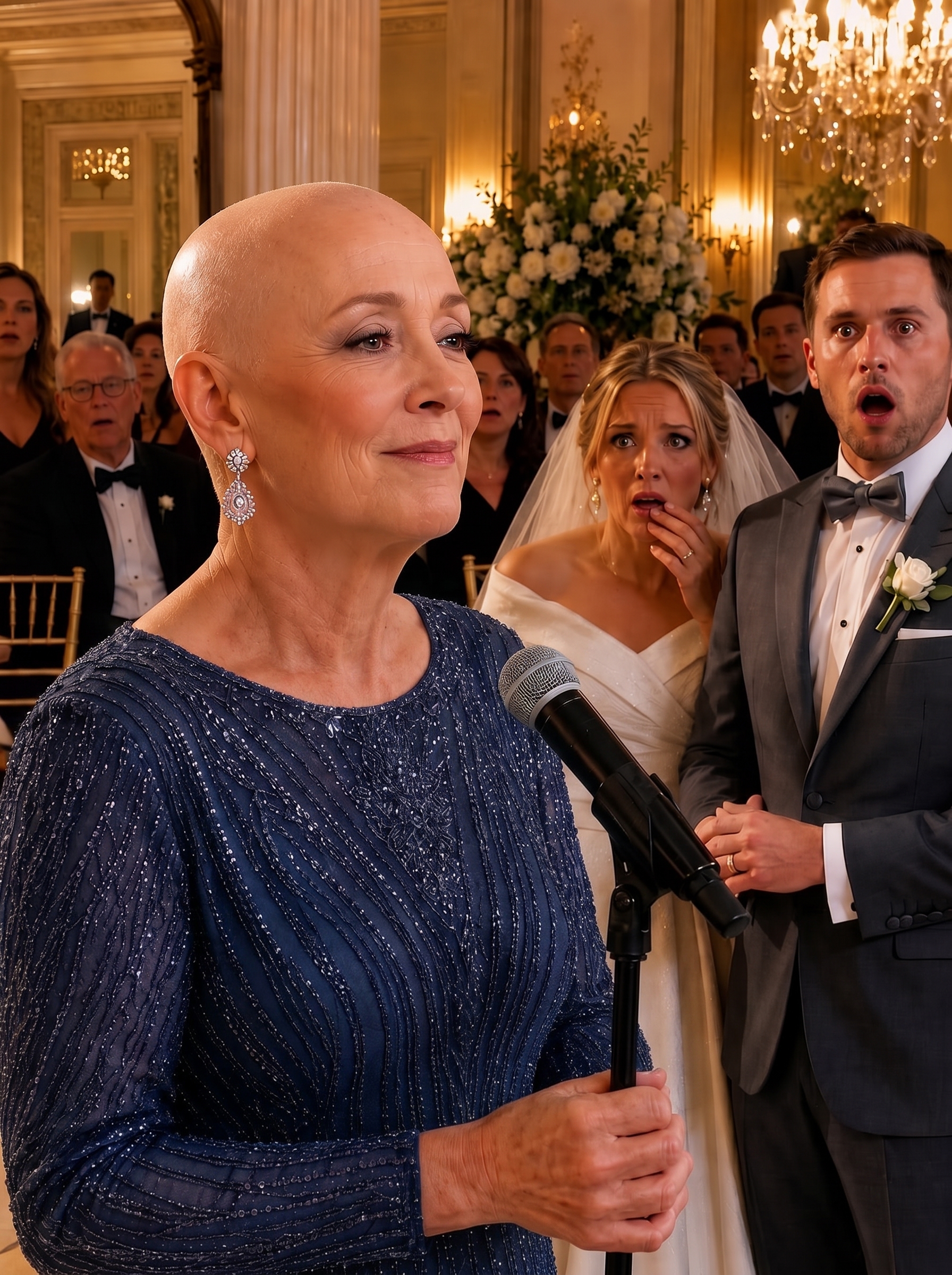
The microphone felt cold beneath my fingers.
For one brief second, the ballroom seemed impossibly large.
Nearly three hundred guests sat beneath crystal chandeliers while candles flickered inside tall glass holders.
White roses covered every table.
The band had stopped playing.
Waiters stood silently along the walls.
At the center table, Natalie leaned against Jackson’s shoulder with one hand resting possessively on his arm.
She looked radiant.
Her dark hair was arranged beneath an antique veil.
Diamonds glittered at her throat.
Her white satin dress had cost more than many families earned in a year.
I had paid for all of it.
When she saw me standing at the microphone, her smile widened.
She expected a blessing.
She expected gratitude.
Most of all, she expected silence.
Inside my purse was the note she had left beside my bed after shaving my head.
Now you finally have the look that suits you, you ridiculous old woman.
Inside my attorney’s briefcase were the documents canceling the transfer of one hundred twenty million dollars.
And standing beside the ballroom entrance was Adrian Cole, the financial adviser who had managed our family holdings for almost twenty years.
Natalie had noticed neither him nor my attorney.
She was too busy enjoying what she believed was her victory.
I looked at Jackson.
My only child.
Frank’s son.
The boy I had once carried through a snowstorm after his school bus became stranded.
The teenager who sat beside me throughout his father’s first surgery.
The man who had looked at my shaved head only hours earlier and accused me of trying to ruin his wedding.
That betrayal hurt more than Natalie’s cruelty.
A stranger could humiliate me.
Only my son could make me wonder whether I had lost the family I spent my entire life building.
The guests waited.
I took a breath.
“When Jackson was eight years old,” I began, “he asked his father how a person could tell whether someone truly loved them.”
A few guests smiled.
Jackson looked surprised.
Natalie maintained her expression.
“Frank gave him an answer that I never forgot.”
“He said love becomes clearest when kindness is inconvenient.”
The room became quieter.
“When everything is easy, almost anyone can behave lovingly.”
“But when kindness requires sacrifice, honesty, courage, or patience, that is when character becomes visible.”
I paused.
“This morning, character became very visible.”
Natalie’s smile tightened.
Jackson shifted in his chair.
Judith stood near the side wall wearing a dark green dress.
She held my eyes and nodded.
Continue.
I reached into my purse.
Natalie saw the folded paper.
The color left her face.
“This note was waiting beside my bed when I woke this morning.”
I unfolded it.
Jackson stood.
“Mom.”
His voice traveled across the ballroom.
It contained a warning.
I looked at him.
“Please sit down.”
“This is not the place.”
“I agree.”
“This should never have happened here.”
“Or anywhere.”
Natalie reached for his sleeve.
“Jackson, she’s doing exactly what I warned you about.”
I turned toward the guests.
“My future daughter-in-law entered my bedroom while I was sedated by medication, shaved my head, destroyed my dress, removed my jewelry box, and left this note.”
Gasps moved across the tables.
Someone dropped a fork.
The sharp sound struck the floor and echoed.
Natalie rose slowly.
“That is a lie.”
I held up the note.
“Would you like to read your handwriting aloud?”
“You wrote that yourself.”
“Why would I do that?”
“To destroy me.”
Her answer came too quickly.
Several guests turned toward one another.
Jackson looked from her to me.
His face had begun to change.
Not into belief.
Into confusion.
That hurt too.
He should not have needed an audience before considering that his mother might be telling the truth.
Natalie pressed one hand against her chest.
“She has hated me from the beginning.”
I almost laughed.
Instead, I looked at the woman who had spent months teaching my son to interpret every boundary as jealousy.
“I welcomed you into our family.”
“I paid for this wedding.”
“I offered you my grandmother’s pearls.”
“You called them old-fashioned.”
“I included Frank’s favorite meal in the menu.”
“You removed it because you said it looked cheap.”
“I respected every choice that belonged to you.”
“What I did not do was surrender every piece of myself.”
Natalie turned toward Jackson.
“Are you going to let her humiliate me?”
The sentence told the room everything.
Not defend me from a false accusation.
Not ask whether I was injured.
Not explain where she had been overnight.
Humiliate me.
Her first concern was still how she appeared.
Jackson approached the microphone.
His jaw was tight.
“Mom, stop.”
“I called you this morning.”
“You ignored me.”
“I was preparing for the ceremony.”
“I told you something terrible had happened.”
“You said Natalie couldn’t have done it.”
“Because she was with her bridesmaids.”
The maid of honor, Vanessa Hart, looked down.
I noticed.
So did Judith.
“Was she?” I asked.
Jackson turned toward Vanessa.
The entire head table followed his gaze.
Vanessa’s hand tightened around her champagne glass.
Natalie spoke before she could answer.
“Of course I was.”
“Vanessa?”
Jackson’s voice sharpened.
“Tell her.”
Vanessa did not look at Natalie.
“She left for a while.”
Silence fell.
Natalie stared at her.
“What are you doing?”
“You left the suite around two.”
“I couldn’t sleep.”
“You said you needed air.”
“You came back after four.”
Natalie’s face hardened.
“You were asleep.”
“I wasn’t.”
Vanessa lowered her glass.
“You came back carrying a black bag.”
A murmur moved through the room.
Jackson looked at his new wife.
“What black bag?”
“My toiletries.”
“Why did you take toiletries outside the hotel?”
“I went to the spa.”
“At three in the morning?”
Natalie’s father stood from a nearby table.
“Enough.”
Richard Vale had spent the wedding planning speaking to everyone as if his wealth made every room belong to him.
He owned a chain of luxury car dealerships and enjoyed reminding people that his family had been successful before Natalie met Jackson.
He pointed toward me.
“This woman is clearly unwell.”
Judith stepped forward.
“Be careful, Richard.”
He turned toward her.
“And who are you?”
“The woman who picked up her sister this morning after your daughter shaved her head.”
A few guests gasped again.
Richard’s wife, Elaine, covered her mouth.
Judith continued walking until she stood beside me.
“I saw the destroyed dress.”
“I photographed the bedroom.”
“I spoke with the housekeeper.”
“And I watched Evelyn’s attorney preserve the security records.”
Natalie’s confidence cracked.
Only slightly.
But I saw it.
Jackson saw it too.
“Security records?” he asked.
I nodded.
“My alarm was disarmed at 2:26 this morning using the temporary code Natalie requested last month.”
Natalie shook her head.
“You gave me that code.”
“To deliver wedding materials.”
“That does not authorize entering my bedroom while I sleep.”
“I never went into your room.”
“My housekeeper saw you leaving it.”
“She’s lying.”
“The hallway camera recorded you.”
That part was not entirely true.
The camera showed Natalie entering the bedroom corridor and later leaving the house.
It did not show the bedroom door.
But Natalie did not know exactly what we had.
Her eyes flickered toward the ballroom exit.
My attorney noticed.
So did the two hotel security officers now standing near the doors.
I had not called police before the ceremony.
At first, I wanted to protect Jackson’s wedding.
Then I wanted to make sure the evidence was preserved properly.
My attorney had contacted the authorities while I attended the ceremony.
They were waiting outside.
Natalie looked at me.
“You planned this.”
“No.”
“You planned this wedding morning.”
“I planned to give you one hundred twenty million dollars tomorrow morning.”
That sentence froze the room more completely than anything before it.
Many guests knew our family was comfortable.
Very few knew the amount involved.
Jackson’s face changed.
“Mom.”
Natalie stared at me.
For the first time all evening, she looked frightened.
I folded the note.
“The transfer has been canceled.”
Her fear became rage.
“You can’t do that.”
The words left her before she could stop them.
People turned toward her.
Jackson stepped backward.
“What did you say?”
Natalie recovered too late.
“I mean she can’t punish you because she hates me.”
“The money belongs to her,” Jackson said.
His voice had become quiet.
“She promised it.”
“A promise is not a completed transfer.”
“You said the paperwork was signed.”
“It was.”
“I revoked it.”
Natalie looked toward Adrian Cole.
She recognized him at last.
He gave her a small professional nod.
“The cancellation was completed at 2:17 this afternoon,” he said.
“No funds will be transferred.”
Richard moved toward him.
“You have no right to discuss private financial matters here.”
Adrian did not move.
“I am speaking at my client’s direction.”
“Your client is clearly incompetent.”
There it was.
The word Natalie had been preparing guests to accept.
Incompetent.
Unstable.
Old.
Unable to manage herself.
A woman who needed professional care.
Richard had said it too easily.
As if the family had already discussed it.
I looked at Natalie.
“This was not only about money, was it?”
She laughed bitterly.
“What else would it be about?”
Jackson turned toward her.
“What does that mean?”
“I didn’t mean it that way.”
I addressed the room again.
“During cocktail hour, Natalie told several guests that I may require professional care after the honeymoon.”
“I heard her.”
A woman at the third table stood.
Her name was Dr. Rebecca Mills.
She had known Jackson since college.
“I heard it too.”
Another guest raised her hand.
“So did I.”
Natalie looked around.
“I was worried about her.”
“You told us she was showing signs of cognitive decline,” Rebecca said.
“You said Jackson had already spoken with a residential facility.”
Every face turned toward my son.
Jackson looked stunned.
“I never spoke with any facility.”
Natalie reached for him.
“Jackson, I was trying to prepare people.”
“For what?”
“For the reality that your mother is getting older.”
“Getting older is not the same as losing capacity.”
“She forgets things.”
“What things?”
Natalie hesitated.
“Appointments.”
“Names.”
“She called me Vanessa last month.”
Vanessa looked up.
I remembered the moment.
Natalie and Vanessa had been standing together while I was reviewing the seating chart.
I addressed Vanessa because she had asked the question.
Natalie later insisted I had confused them.
A small distortion.
Planted early.
Repeated until it became a pattern.
“I did not confuse your names,” I said.
“I was answering Vanessa.”
Natalie threw up her hands.
“Of course you have an explanation for everything.”
“Evidence often provides explanations.”
My attorney, Marcus Ellison, crossed the ballroom.
He carried a dark folder beneath one arm.
“Mrs. Callahan,” he said to me, “the officers are ready when you are.”
Jackson’s head snapped toward him.
“Officers?”
Natalie moved toward the exit.
The hotel security guards stepped into her path.
Her father shouted.
“You cannot detain my daughter.”
A uniformed officer entered.
“We need to speak with Mrs. Callahan regarding an alleged assault, unlawful entry, destruction of property, theft, and possible administration of an unknown substance.”
The ballroom erupted.
Guests began speaking at once.
Chairs moved.
Phones appeared.
Natalie’s mother started crying.
Jackson stood completely still.
I touched the silver wig Judith had helped secure over my bare scalp.
Until that moment, I had not fully considered the medication.
I slept deeply because my doctor had prescribed a mild sleep aid after Frank’s death.
I used it only occasionally.
The bottle had been moved from my bathroom cabinet to the nightstand.
I did not remember taking it.
I remembered drinking tea before bed.
My housekeeper, Elena, had prepared it and left it outside my room.
Security footage showed Natalie entering the kitchen.
A half-empty bottle of a stronger sedative had been found inside the black bag discovered beneath a chair in the bridal suite.
I had not mentioned that during the toast.
The police did.
Natalie’s face emptied.
Jackson looked at her.
“What did you give my mother?”
“Nothing.”
“What was in the bag?”
“I don’t know.”
“It isn’t mine.”
Vanessa stood.
“It is your bag.”
“No, it isn’t.”
“You brought it to my apartment last month.”
“You asked me to hold it because Jackson was looking for something in your closet.”
Natalie stared at her maid of honor.
“Stop talking.”
Vanessa began crying.
“I should have stopped this months ago.”
Richard rushed toward his daughter.
The officer raised one hand.
“Sir, stay where you are.”
“This is her wedding.”
“This conversation concerns a possible crime.”
Jackson looked toward me.
For the first time since morning, anger had left his face.
What remained was horror.
“Mom.”
I could not answer him.
Not yet.
Natalie was escorted from the ballroom still wearing her wedding dress.
The long satin train dragged across the floor behind her.
Guests moved out of the way.
No one took photographs openly.
Several people held phones beneath tables.
Her veil caught against the leg of a chair.
She turned furiously when a security guard freed it.
“You’re enjoying this,” she shouted at me.
“No.”
I spoke truthfully.
“I wanted a daughter.”
“I wanted my son to be happy.”
“You wanted to control him.”
“No.”
“I wanted to know that the person beside him would be kind when kindness became inconvenient.”
She looked toward Jackson.
“Tell them to stop.”
He stared at her.
“What did you put in my mother’s tea?”
“I said nothing.”
“Why was the sedative in your bag?”
“It wasn’t my bag.”
“Why did you tell people she needed to be institutionalized?”
“Because she does.”
The final mask disappeared.
The room heard it.
Jackson heard it.
I heard the coldness my instincts had detected from the beginning.
Natalie pointed toward my head.
“Look at her.”
“She came to our wedding wearing a wig and making accusations because she cannot stand that you chose me.”
Jackson’s voice broke.
“She’s wearing a wig because someone shaved her head.”
“She did it herself.”
“Why would she destroy her own dress?”
“To frame me.”
“Why?”
“For attention.”
The officer guided Natalie toward the doors.
Richard and Elaine followed.
Before disappearing into the hallway, Natalie looked back at me.
“This isn’t over.”
She was right.
But not in the way she believed.
THE BALLROOM AFTER THE BRIDE LEFT
The doors closed.
No one moved.
The wedding cake stood untouched beneath soft golden lights.
A sugar replica of Natalie and Jackson smiled from the top.
The band members watched one another, unsure whether to pack their instruments or wait for instructions.
The caterers stood beside trays of food that had cost more than my first house.
Jackson remained near the center of the dance floor.
A gold wedding band circled his finger.
His wife had just been taken away by police.
His mother had exposed the reason during what should have been a loving toast.
Nothing about the moment felt victorious.
I handed the microphone to the bandleader.
Then I walked toward my son.
He looked at my silver wig.
“Can I see?”
The question was barely audible.
I knew what he meant.
Judith touched my arm.
“You don’t have to.”
But Jackson needed to understand what he had refused to see that morning.
I reached beneath the edge of the wig.
My fingers found the small clips Judith had secured.
One by one, I released them.
Then I lifted the wig from my head.
Gasps came from nearby tables.
My scalp was smooth except for several small cuts where the razor had caught the skin.
A dark bruise marked the area above my ear.
Jackson stared.
His entire face collapsed.
“Oh, God.”
He lifted one hand but stopped before touching me.
“Did she do that?”
“I believe she did.”
“I thought—”
“I know what you thought.”
“She told me you had been threatening to stop the wedding.”
“Did you ask me?”
“No.”
“She said you wanted me to choose.”
“Did I ever ask you to?”
“No.”
“Then why did you believe her?”
He began crying.
The room around us disappeared.
For a moment, he was no longer a groom beneath chandeliers.
He was my son.
And I was a mother standing before the consequences of every warning I had softened because I feared losing him.
“I don’t know,” he whispered.
“Yes, you do.”
His eyes lifted.
“You believed her because she made doubt feel like loyalty.”
“You thought questioning her would mean betraying your marriage before it began.”
“So you betrayed me instead.”
He covered his face.
“I’m sorry.”
“Not here.”
“What?”
“Do not apologize because people are watching.”
“Do it when there is no audience and nothing to gain.”
He lowered his hands.
The words hurt him.
They were meant to.
Not as punishment.
As truth.
I replaced the wig.
Judith secured the clips.
Then I faced the room.
“I am sorry that all of you were brought into something painful and private.”
“You are welcome to eat, drink, dance, or leave.”
“The staff will be paid.”
“The vendors will be paid.”
“No employee will lose income because this celebration ended differently than expected.”
The catering manager’s eyes filled.
That detail mattered to me.
Natalie and Jackson’s decisions had already consumed enough people.
The workers who prepared the room should not become collateral damage.
I looked at the untouched cake.
“Please serve dessert.”
Someone near the back laughed nervously.
Then another person did.
The tension loosened slightly.
The band began playing quiet instrumental music.
Guests formed small groups.
Some left.
Others stayed because shock often makes people unsure where else to go.
The wedding reception became something stranger.
A room filled with witnesses waiting for the truth to settle.
THE WAITER’S RECORDING
The young waiter who approached me during cocktail hour introduced himself as Mateo Alvarez.
He was twenty-two and working two jobs while studying hospitality management.
He found Judith and me near the service corridor.
“I recorded part of what she said,” he told us.
My attorney joined us.
“Why?”
Mateo looked embarrassed.
“My supervisor says we should never record guests.”
“But she was talking about hurting you.”
“What exactly did you hear?”
Mateo took out his phone.
“I was clearing glasses behind the curtain.”
“She didn’t know I was there.”
The recording began with laughter.
Natalie’s voice was unmistakable.
The old woman looked like a boiled egg when I left.
One bridesmaid laughed.
Another asked whether I might call police.
Natalie answered:
She’ll blame herself for taking the pills.
Old people forget things.
By tomorrow, we’ll have the money.
By next month, Jackson will sign the care papers.
Then we can move her somewhere quiet and sell the lake property.
My knees weakened.
Judith caught my arm.
The lake property had belonged to Frank’s parents.
He restored the cabin himself.
Jackson learned to swim there.
I had no intention of selling it.
More importantly, Jackson could not sign care papers placing me anywhere.
Not while I remained legally competent.
Unless someone manufactured evidence suggesting otherwise.
Marcus took the phone.
“Who else was speaking?”
Mateo identified Vanessa and two bridesmaids named Chloe and Paige.
Vanessa’s voice appeared briefly.
This is going too far, Nat.
Natalie replied:
It went exactly far enough.
She won’t show her bald head in front of three hundred people.
Jackson will think she is having another episode.
Another episode.
The phrase was deliberate.
Prepared.
“Did I have a first episode?” I asked.
Judith’s face changed.
Marcus answered carefully.
“We need to review your recent medical records.”
“Why?”
“If Natalie has been building a competency case, she may have communicated with medical professionals.”
I remembered a wellness appointment three months earlier.
My doctor asked whether I had experienced confusion.
I said no.
He mentioned that a family member had reported two incidents.
I assumed Jackson had misunderstood something.
When I asked him, he said he knew nothing about it.
Natalie had been sitting in the waiting room.
“She contacted my doctor.”
Marcus’s expression remained cautious.
“Possibly.”
Mateo looked horrified.
“I’m sorry.”
“You did the right thing by saving this.”
“Will I lose my job?”
The catering manager had approached behind him.
“No,” she said.
Mateo turned.
She looked at me.
“We have policies about recording guests.”
“We also have policies requiring employees to report threats and unsafe conduct.”
“Mateo’s job is secure.”
I thanked her.
Marcus arranged for police to receive a preserved copy.
Before leaving, Mateo asked one question.
“Did you really stop the money?”
“Yes.”
A small smile crossed his face.
“Good.”
THE MISSING JEWELRY BOX
Police found my jewelry box inside Natalie’s hotel suite.
Several pieces were missing.
Frank’s watch was gone.
So was the emerald necklace he gave me on our fortieth anniversary.
My grandmother’s pearls remained because Natalie had dismissed them as old-fashioned.
The irony would have amused me under different circumstances.
The black bag contained an electric razor, disposable gloves, strands of silver hair, the sedative bottle, and pieces of my ruined blue dress.
Natalie had kept everything.
Not because she needed it.
Because she believed she would never be searched.
Confidence had made her careless.
A receipt from a twenty-four-hour pharmacy showed that she purchased the gloves and razors at 1:41 that morning.
The sedative had been prescribed to her father.
Richard claimed he did not know how she obtained it.
Investigators discovered that he had reported the bottle missing two weeks earlier.
The timing suggested preparation.
My housekeeper, Elena, gave a statement.
She saw Natalie enter my bedroom at approximately 2:38.
She heard the electric razor through the door.
“Why didn’t you stop her?” an officer asked.
Elena cried.
“Natalie told me Mrs. Callahan had become ill.”
“She said shaving her hair was necessary before an emergency medical treatment.”
“Did that seem believable?”
“No.”
“Then why did you allow it?”
“She said Jackson knew.”
“She threatened to have me fired if I interfered.”
Elena had worked for me for eleven years.
I had never told Natalie she could fire anyone.
But Elena knew Natalie would soon become part of the family.
She believed the financial transfer would give her power over the household.
Fear did the rest.
“I should have called you,” Elena told me.
“Yes.”
“I’m sorry.”
“I believe you.”
That did not erase her silence.
It did separate it from Natalie’s intent.
She cooperated completely.
She also revealed something else.
Natalie had entered my study on three previous occasions while I was away.
Once, Elena found her photographing documents from my desk.
“What documents?”
“I don’t know.”
“Insurance papers.”
“Property records.”
“Something with Jackson’s name.”
My attorney and I went directly to the house.
The study looked untouched.
Then Marcus examined the locked cabinet containing my estate plan.
The lock bore scratches.
Inside, the folders appeared orderly.
One document was missing.
My durable power of attorney.
THE NAME ON THE DOCUMENT
My existing power of attorney named Judith.
Frank and I made that decision years earlier.
If I became unable to manage my affairs, my sister would act for me.
Jackson knew.
He had agreed.
The original document was missing.
A copy remained with Marcus.
“Can Natalie use the original?”
“Not legally while you retain capacity.”
“Could she alter it?”
“She could try.”
“Could Jackson replace Judith?”
“No.”
“Only you can change the appointment while competent.”
“Then why steal it?”
Marcus looked at the empty space in the cabinet.
“To understand what she needed to defeat.”
The answer chilled me.
Natalie was not merely waiting for the inheritance transfer.
She was studying the structure around the rest of my fortune.
The one hundred twenty million was only the beginning.
Frank and I had built a manufacturing and logistics company valued far beyond that amount.
I retained controlling interests through several trusts.
The lake property, investment portfolio, real estate holdings, and charitable foundation were worth hundreds of millions more.
Jackson would inherit much of it eventually.
But eventually had never been enough for Natalie.
“If she planned to prove I was incompetent, what would happen?” I asked.
“Judith would receive authority.”
“Not Jackson.”
“Correct.”
“Then she would need to remove Judith too.”
Marcus became still.
Judith looked at him.
“What?”
He turned toward her.
“Have you experienced anything unusual recently?”
“What kind of unusual?”
“Accidents.”
“Medical complaints.”
“Threatening messages.”
Judith laughed once.
Then she stopped.
“My brakes failed last week.”
The room became silent.
“What happened?”
“I was pulling out of my garage.”
“The pedal went to the floor.”
“I hit the hedge.”
“The mechanic said a line had been damaged.”
“Damaged how?”
“He said it looked cut.”
I grabbed the edge of the desk.
“Did you report it?”
“No.”
“I assumed something in the garage caused it.”
“Who knew your car would be there?”
Judith looked at me.
“Natalie visited the day before.”
THE PLAN WAS LARGER THAN THE WEDDING
Police inspected Judith’s car.
The brake line had been cut deliberately.
Security footage from a neighboring house showed a dark SUV stopping near her driveway at 3:12 in the morning.
The vehicle resembled one registered to Richard’s dealership network.
The license plate was obscured.
Natalie denied involvement.
Richard denied lending her a vehicle.
His dealership claimed the SUV had been taken for a customer test drive, but no customer information appeared in the records.
The investigation expanded.
What began as humiliation on a wedding morning now looked like part of a coordinated attempt to isolate me, discredit my judgment, and remove the person legally authorized to protect my interests.
Jackson sat in my kitchen while detectives searched the study.
He had changed out of his tuxedo.
The wedding band remained on his finger.
He turned it slowly.
“How much did she know?”
“About what?”
“The estate.”
“Enough.”
“Did you tell her?”
“Not everything.”
His eyes avoided mine.
“What did you tell her?”
“That the transfer was planned.”
“That I would eventually inherit controlling shares.”
“That Judith had power of attorney.”
I felt Judith stiffen beside me.
“You told Natalie about the document?”
“She was going to be my wife.”
“She was your wife for less than six hours before police took her away.”
Jackson closed his eyes.
“I trusted her.”
“So did I.”
“No.”
“You were suspicious.”
“I was cautious.”
“There is a difference.”
He looked toward the investigators.
“Did she cut Judith’s brakes?”
“We don’t know yet.”
“If she did—”
He could not finish.
I sat across from him.
“When did she first tell you I was declining?”
“Months ago.”
“What did she say?”
“That you repeated yourself.”
“That you forgot conversations.”
“That you had become paranoid about money.”
“Did you observe any of that?”
“Sometimes you asked the same question twice.”
“I managed a wedding budget involving thirty vendors.”
“I asked repeated questions because details changed.”
“I know that now.”
“No.”
“You know her story has become inconvenient.”
“That is different from knowing me.”
The words struck him.
He looked down.
“Why didn’t you talk to me?”
“I tried.”
“When?”
“Every time you told me Natalie’s jokes were harmless.”
“Every time I asked why she needed details about the trusts.”
“Every time I said the transfer should wait until after you had been married for a year.”
“You accused me of controlling you.”
He looked ashamed.
“She said you would.”
“Of course she did.”
I softened my voice without softening the truth.
“She prepared you to reject every warning before I gave it.”
Jackson removed the wedding ring.
He placed it on the table.
The small sound it made against the wood felt louder than the ballroom applause had.
“What do I do now?”
“You tell the truth.”
“All of it.”
“Even the parts that make you look foolish.”
“Especially those.”
THE PRENUPTIAL AGREEMENT
Jackson and Natalie had signed a prenuptial agreement.
At least, I believed they had.
My attorneys insisted on one before I agreed to schedule the transfer.
The document protected inherited family assets.
It also stated that the one hundred twenty million would remain Jackson’s separate property unless he voluntarily combined it with marital funds.
Marcus requested the final signed copy.
Jackson searched his email.
Then his cloud storage.
He found the version he signed.
Natalie’s signature appeared on the final page.
The notary seal looked authentic.
Marcus examined it for less than a minute.
“This is not the version my office prepared.”
Jackson stared at him.
“What?”
“Section fourteen has been replaced.”
“What does it say?”
Marcus turned the document toward us.
In the event of divorce within the first ten years, any marital gift transferred within thirty days of the wedding would be divided equally.
Jackson’s face went white.
“She changed it?”
“The page formatting is slightly different.”
“The numbering also skips one subsection.”
“But I signed every page.”
“You signed the version sent to you.”
“This final file may have been assembled afterward.”
“What about the notary?”
“We will contact her.”
The notary was Paige Benton.
One of Natalie’s bridesmaids.
Paige had disappeared from the hotel before police arrived.
Her phone was off.
Her apartment was empty.
And according to airline records, she had booked a one-way flight scheduled to leave the country that night.
Police stopped her at the airport.
Inside her luggage, they found the missing emerald necklace, Frank’s watch, and a flash drive containing scanned copies of my estate documents.
THE BRIDESMAID WHO KNEW TOO MUCH
Paige asked for an attorney immediately.
By morning, she asked for a deal.
She had known Natalie since boarding school.
Their friendship rested on secrets, competition, and the belief that rules existed mainly for people without money.
Paige admitted altering the prenuptial agreement.
She also admitted notarizing signatures she did not witness.
But she denied touching Judith’s car or entering my house.
“Natalie said Evelyn had promised Jackson everything,” Paige told investigators.
“She said the transfer was only being delayed because Evelyn wanted attention.”
“Did you know Mrs. Callahan opposed the altered agreement?”
“I assumed she would.”
“Then you knew it was fraudulent.”
Paige looked down.
“Yes.”
“What was your payment?”
“Two million after the transfer.”
“Did Natalie tell you where the money would come from?”
“She said Jackson would never notice.”
Jackson heard the recorded interview in Marcus’s office.
He stood near the window with his back to us.
When Paige described the plan, he did not move.
Afterward, he asked one question.
“Did Natalie ever love me?”
No one could answer.
Love may have existed somewhere inside her.
But a feeling hidden beneath manipulation, humiliation, fraud, and violence could not make any of those actions safe.
I said the only thing I knew.
“Whatever she felt, she was willing to destroy you to possess what surrounded you.”
Jackson looked at me.
“And I helped her.”
“Yes.”
He began crying.
This time, no ballroom watched.
No guests waited to judge the apology.
He sat on the floor beside the window and covered his face.
“I helped her build the case against you.”
“Yes.”
“I told her about Judith.”
“Yes.”
“I gave her access to the house.”
“Yes.”
“I called you unstable.”
“Yes.”
Each answer landed without rescue.
Finally, he whispered, “I’m sorry.”
I believed he meant it.
I was not ready to comfort him.
Both truths could exist together.
THE WOMAN BEHIND RICHARD’S DEALERSHIP
The SUV near Judith’s house was traced through a maintenance record.
It belonged to a holding company connected to Richard Vale’s dealerships.
The vehicle had been signed out by Richard’s executive assistant, Monica Shaw.
Monica claimed Richard instructed her to make it available to Natalie.
Richard denied it.
Then investigators found deleted messages.
Richard: The sister is the obstacle.
Natalie: I know.
Richard: If Evelyn becomes incapable, Judith controls everything.
Natalie: Not if Judith is unavailable.
Richard: Do not write details here.
The messages did not explicitly order violence.
They revealed knowledge.
A second conversation was worse.
Natalie: Brake problem looked natural.
Richard: And yet she walked away.
Natalie: I will handle another way after the wedding.
Richard: Secure the transfer first.
Richard was arrested.
Elaine Vale filed for divorce within forty-eight hours.
She also surrendered financial records showing that her husband’s dealership group was near collapse.
The family’s public wealth was built on debt.
Several locations had been used as collateral repeatedly.
Lenders were preparing to act.
Natalie did not want luxury because she had always possessed it.
She needed my money to prevent her family’s collapse.
That explained the urgency.
It did not excuse anything.
Richard had treated Jackson’s inheritance as a rescue package.
Natalie had treated marriage as the delivery system.
THE DAY AFTER THE WEDDING
The morning after the ceremony, the canceled transfer would have occurred at nine.
At 8:55, I sat in Adrian’s office with Judith and Marcus.
Jackson waited outside.
The transaction screen still displayed the old scheduled instruction.
$120,000,000.
Recipient trust: Jackson Callahan Marital Holdings.
Status: Revoked.
At nine, nothing moved.
No money left the account.
No marital holding received a dollar.
Adrian closed the file.
“It’s done.”
I expected satisfaction.
Instead, I thought of Frank.
We planned the gift during his final year.
He wanted Jackson to have freedom.
Time.
Security.
The ability to raise children without letting work consume every evening.
Frank had not imagined our gift becoming bait.
“Did I make the amount too important?” I asked.
Judith looked at me.
“What do you mean?”
“Did Jackson grow up believing marriage would unlock a fortune?”
Marcus answered carefully.
“Large inheritances affect families even when handled responsibly.”
“That does not make you responsible for fraud.”
“I promised the money.”
“To your son.”
“He built his future around it.”
“Then stopping the transfer may force him to build a future around something else.”
The thought hurt.
It also felt necessary.
I asked Jackson to enter.
He sat across from me.
His eyes were swollen.
“I am not transferring the money.”
“I understand.”
“Not tomorrow.”
“Not after an annulment.”
“Not when the criminal case ends.”
He swallowed.
“Will you ever?”
“I don’t know.”
The answer shocked him.
It shocked me too.
“You said it was Dad’s wish.”
“Your father wanted to protect your future.”
“He did not want to finance people trying to destroy mine.”
“I didn’t know.”
“You refused to know.”
“That distinction matters.”
Jackson lowered his head.
“What happens to the money?”
“It remains where it is.”
“Some may enter the family foundation.”
“Some may support other plans.”
“It is no longer part of your immediate life.”
He nodded slowly.
“I understand.”
“No.”
“You accept the words because you have no power to change them.”
“Understanding will take longer.”
I slid a folder toward him.
It contained information for an independent therapist.
“I will not repair this for you.”
“I will not manage your annulment.”
“I will not speak to the press.”
“I will not pay for a private public-relations campaign.”
“You will handle the consequences of choosing someone’s story about me over the mother you knew.”
Tears returned to his eyes.
“Are you cutting me off?”
“Financially, yes.”
“Emotionally?”
“I am setting a boundary.”
“What does that mean?”
“It means I love you.”
“It also means love does not give you immediate access to the person you helped endanger.”
He stared at the folder.
“How long?”
“There is no schedule.”
“Change without a guaranteed reward is the only kind I can trust.”
THE SILVER HAIR
My hair did not return quickly.
For weeks, I wore Judith’s silver wig.
At first, every mirror felt like another witness.
I imagined Natalie standing behind me with the razor.
I imagined the laughter recorded on Mateo’s phone.
The old woman looked like a boiled egg.
Then one morning, I removed the wig before a foundation meeting.
I stood beneath the bathroom light and studied the soft gray growth covering my scalp.
It was uneven.
Visible.
Mine.
I attended the meeting without hiding it.
Several board members looked surprised.
No one asked a careless question.
At the end, a woman named Miriam touched her own short hair.
“I lost mine during chemotherapy,” she said.
“I thought everyone was looking at me.”
“Were they?”
“Some.”
“Then I realized people looking did not have the power to tell me what I looked like.”
The sentence stayed with me.
Natalie shaved my head because she believed appearance determined dignity.
She believed an older woman could be made ridiculous by removing the part of her that looked graceful.
But dignity had never lived in my hair.
It lived in the decision to enter the ballroom.
It lived in the canceled transfer.
It lived in the truth spoken beneath the chandeliers.
I stopped wearing the wig.
Judith asked whether she could keep it.
“Why?”
“It cost a fortune.”
“What will you do with it?”
“Wear it when I want to look wiser.”
I laughed for the first time in weeks.
THE FOUNDATION
Frank and I created the Callahan Foundation to support technical education, medical research, and small manufacturing communities.
After the wedding, I expanded its mission.
One hundred twenty million dollars remained in the family trust.
I did not donate all of it.
I was not making a dramatic gesture to punish Jackson.
I wanted the money handled thoughtfully.
But I transferred twenty million into a new initiative supporting older adults targeted through financial exploitation, coercive guardianship, and manufactured claims of incompetence.
We called it the Clear Voice Project.
The organization funded legal representation, capacity evaluations, emergency housing, and secure financial reviews.
During the first year, it helped a seventy-two-year-old woman whose nephew tried to place her under guardianship after she refused to sell her farm.
It helped a retired teacher whose daughter redirected pension checks.
It helped an eighty-year-old widower whose caregiver isolated him while transferring property.
Every case reminded me that Natalie’s plan was not unique.
Age made people visible as targets and invisible as witnesses at the same time.
The world was often too willing to hear that an older woman was confused.
Especially when the accusation came from a younger relative speaking calmly.
THE ANNULMENT
Jackson filed for annulment three days after the wedding.
Natalie contested it.
She claimed he acted under my influence.
She demanded temporary access to marital resources.
Her attorney cited the altered prenuptial agreement.
Paige’s testimony destroyed that strategy.
The court invalidated the fraudulent document.
Because the marriage had lasted only hours before separation and involved proven deception, the proceedings moved more quickly than expected.
Natalie still fought every step.
During a hearing, she looked directly at Jackson.
“Your mother will never respect you.”
Jackson answered quietly.
“This hearing is not about my mother.”
“It is about what you did.”
“She made you say that.”
“No.”
“She spent my entire life protecting me from consequences.”
“That was one of her mistakes.”
I heard about the exchange from Marcus.
I did not attend.
Jackson needed to stand without checking whether I approved.
The annulment was granted.
His wedding band remained inside an evidence envelope because traces of the sedative had been found on the black bag stored beside it.
THE CRIMINAL CASE
Natalie faced charges for assault, burglary, theft, administering a substance without consent, destruction of property, fraud, conspiracy, and offenses connected to Judith’s brake line.
Richard faced conspiracy, attempted financial exploitation, obstruction, fraud, and involvement in the vehicle incident.
Paige pleaded guilty to forgery and conspiracy under a cooperation agreement.
Vanessa was not charged.
Her early knowledge had been limited, but investigators confronted her about remaining silent after hearing Natalie discuss the humiliation.
She testified.
At trial, prosecutors played Mateo’s recording.
Natalie’s laughter filled the courtroom.
The old woman looked like a boiled egg when I left.
Then came the sentence about the pills.
She’ll blame herself.
Old people forget things.
Jurors looked toward me.
I sat with Judith.
My hair had grown into a short silver cap.
I wore no wig.
Elena testified about the razor.
The pharmacist identified Natalie from the receipt and security footage.
Paige explained the altered prenuptial agreement.
Monica described providing the SUV at Richard’s instruction.
A mechanic testified that Judith’s brake line had been cut with a sharp tool.
Digital records placed Natalie’s phone near Judith’s home that night.
The defense argued that she had visited a nearby friend.
The friend denied it.
Jackson testified last.
His voice shook.
He admitted telling Natalie about the transfer, estate structure, and power of attorney.
He admitted dismissing my warnings.
He admitted receiving messages from me that morning.
“What did you do?” the prosecutor asked.
“I accused my mother of trying to destroy my wedding.”
“Did she?”
“No.”
“Who did?”
Jackson looked at Natalie.
“My wife.”
Natalie showed no emotion.
“What did you learn after the ceremony?”
“That Natalie drugged my mother.”
“That she shaved her head.”
“That she stole documents and jewelry.”
“That she altered our prenuptial agreement.”
“That she and her father planned to obtain control of family assets.”
“And what was your role?”
The defense objected.
The judge allowed the question within limits.
Jackson answered.
“I gave her information.”
“I ignored warning signs.”
“I helped make my mother easier to isolate because I repeated the claim that she was unstable.”
“Did you knowingly participate in the crimes?”
“No.”
“Do you believe your choices caused harm?”
“Yes.”
His honesty did not erase anything.
It mattered anyway.
THE VERDICT
Natalie was convicted on nearly every major charge.
Richard was convicted on the financial and conspiracy counts and on charges related to Judith’s car.
When the verdicts were read, Natalie stared straight ahead.
Her face remained calm until the clerk confirmed the conspiracy conviction.
Then she looked at me.
The hatred in her eyes had not changed.
She still believed the canceled transfer belonged to her.
At sentencing, I stood.
“My hair grew back.”
“The dress was replaced.”
“The jewelry was recovered.”
“Those facts may make what happened appear temporary.”
“It was not.”
“Natalie did not merely shave my head.”
“She tried to turn age into evidence against me.”
“She used humiliation to keep me away from a room where she expected to receive my family’s fortune.”
“She told people I was unstable before I could tell them what she had done.”
“She intended to place me somewhere quiet and take control of my property.”
I looked toward Natalie.
“She believed an older woman could be erased if enough younger people agreed to call her confused.”
“She was wrong.”
I turned toward the judge.
“I am not asking for revenge.”
“I am asking the court to recognize the danger of a plan that used family trust as a weapon.”
The judge imposed a lengthy sentence.
Richard received a substantial sentence of his own.
The court ordered restitution for the stolen property and damage.
Money could not repair the morning.
But the judgment placed responsibility where it belonged.
THE SON OUTSIDE THE GATE
Jackson spent two years rebuilding his life without access to the family fortune.
He sold the luxury apartment he purchased while expecting the transfer.
He moved into a modest rental.
He continued working at the company, but I removed him from the succession plan.
He reported to an independent board member.
He received no special bonuses.
Several executives believed I was punishing him.
I was protecting the business from a man whose judgment had nearly placed family assets inside a criminal conspiracy.
Jackson attended therapy.
He did not send weekly apologies.
He did not appear unexpectedly.
Every three months, he wrote one letter.
He described what he was learning.
He did not ask me to respond.
In the first letter, he wrote:
I thought loyalty meant defending Natalie before I knew the facts.
The truth is that loyalty without honesty became permission.
In the second:
I kept saying you were controlling because it prevented me from asking whether I was being controlled by someone else.
In the fourth:
I miss you.
I know missing you does not create an obligation for you to let me close.
I kept every letter.
I answered none during the first year.
Then, on Frank’s birthday, I wrote:
Your father believed love becomes clearest when kindness is inconvenient.
Accountability becomes clearest when forgiveness is not guaranteed.
Continue.
Jackson did.
THE LAKE HOUSE
Three years after the wedding, I invited Jackson to the lake property.
It was the first time we had been alone together since the canceled transfer.
He arrived early.
He waited outside rather than using his old key.
That mattered.
I opened the door.
His eyes moved toward my hair.
It had grown to my shoulders again.
Silver.
Natural.
“You look like yourself,” he said.
“I always did.”
He nodded.
“You’re right.”
We sat on the porch overlooking the water.
Frank had built the railing himself.
One section remained slightly crooked because he refused to measure twice.
Jackson touched the wood.
“Dad would hate what I did.”
“Your father is not here to give us convenient answers.”
“I hate what I did.”
“That is something you can work with.”
He looked toward the lake.
“I believed she loved me.”
“She may have believed she did.”
“Does that matter?”
“It explains why you stayed.”
“It does not make the danger smaller.”
He turned toward me.
“Do you forgive me?”
“Some of it.”
His face tightened.
“Not all?”
“Not yet.”
He nodded.
“Thank you for being honest.”
“I will never restore the original transfer.”
“I know.”
“Do you?”
“Yes.”
“I spent years thinking that money was the future Dad wanted for me.”
“Now I think he wanted me to become someone capable of carrying it.”
“And I wasn’t.”
I looked at him.
“Are you now?”
“I don’t know.”
It was the first answer that gave me hope.
The old Jackson would have said yes because he wanted the reward.
This man understood that uncertainty could be honest.
“I brought something,” he said.
He returned to his car and carried back a small wooden box.
Inside was Frank’s watch.
Police had returned it after the appeals ended.
The scratches along the band remained.
“Why give it to me?”
“It was stolen from you.”
“Your father intended you to have it someday.”
“Someday should be your decision.”
I closed the box.
“Thank you.”
We stayed on the porch until sunset.
I did not invite him to remain overnight.
He did not ask.
A gate opened slightly.
Neither of us pretended it had disappeared.
THE FIRST DINNER
Six months later, Judith and I invited Jackson to dinner.
He brought flowers.
Not expensive ones.
Wildflowers from a roadside stand.
Judith examined them.
“Did your therapist tell you to buy these?”
“No.”
“Good.”
She placed them in water.
Dinner was awkward.
That was healthier than pretending.
Jackson asked about the Clear Voice Project.
I told him about a woman named Louise whose grandson tried to obtain guardianship after she refused to finance his business.
“Did she win?”
“Yes.”
“Does she still speak to him?”
“No.”
Jackson looked down.
“Sometimes consequences remain even after the court case.”
“Yes.”
He met my eyes.
“I know.”
After dessert, Judith retrieved the silver wig.
She placed it on Jackson’s head.
I stared at her.
“What are you doing?”
“The evening became too serious.”
Jackson looked ridiculous.
For a moment, no one moved.
Then I laughed.
Judith laughed.
Finally, Jackson did too.
The wig shifted over one eye.
It was the first uncomplicated sound we had shared in years.
Healing sometimes arrived inside serious conversations.
Sometimes it arrived through a badly fitted wig at the dinner table.
THE NEW SUCCESSION PLAN
I never returned Jackson to the automatic inheritance plan.
Instead, I created a structure tied to responsibility rather than marriage or age.
A portion of the family assets would remain in protected trusts.
The company would be governed independently.
Jackson could earn leadership through performance and oversight.
He could not inherit control simply because he was my son.
The Clear Voice Project received permanent funding.
Judith remained my power of attorney.
Two independent professionals were added as backups.
No single relative could isolate me or redirect my assets.
I also recorded a formal capacity statement while healthy.
My doctors, attorneys, and advisers kept copies.
The documents could not prevent every future attempt at exploitation.
They made silence much harder to manufacture.
Jackson reviewed the plan with his own attorney.
He did not challenge it.
“This is better than the old transfer,” he said.
“Why?”
“Because the old one would have given me security without requiring judgment.”
“This one protects everyone from the version of me who thought love meant refusing to ask questions.”
I signed the documents.
Frank’s original wish had not disappeared.
It had matured.
THE BRIDE’S FINAL LETTER
Natalie wrote to me from prison.
The first letter blamed her father.
The second blamed financial pressure.
The third blamed Jackson for discussing the inheritance.
I returned them unopened after my attorney summarized their contents.
Years later, one final letter arrived.
This time, Natalie wrote only one page.
Evelyn,
I thought money would make me impossible to humiliate.
I became the person willing to humiliate everyone else first.
I do not expect forgiveness.
I am writing because the woman I was still believes your canceled transfer destroyed my life.
The truth is that it only exposed what I had already decided to become.
Natalie.
I read it twice.
Judith asked what I would do.
“Nothing.”
“Do you believe her?”
“I believe she wrote one honest page.”
“Does that matter?”
“Yes.”
“Does it change the boundary?”
“No.”
Both truths remained.
I placed the letter inside my legal archive.
Not my family box.
Natalie’s accountability belonged to her.
It did not earn a place inside our home.
THE SECOND TOAST
Ten years after the wedding, the Clear Voice Project held its anniversary gala at the Westbrook Hotel.
The same chandeliers glowed above the ballroom.
The same stage stood near the dance floor.
The hotel had replaced the carpet, but I remembered exactly where Natalie sat.
Mateo Alvarez was now the hotel’s general manager.
He greeted me at the entrance.
“I heard you were giving another toast.”
“I’m hoping this one ends with fewer arrests.”
“That would help the schedule.”
Judith attended wearing the silver wig.
Her own hair was still thick, but she claimed the wig had become historically important.
Jackson came alone.
He sat at my table but not beside me.
That seat belonged to Louise, the first woman our project helped.
The ballroom contained attorneys, advocates, physicians, financial advisers, social workers, and survivors.
When I approached the microphone, the room became quiet.
I remembered the note inside my purse ten years earlier.
Now you finally have the look that suits you, you ridiculous old woman.
I no longer carried it.
The original remained in evidence storage.
I did not need it.
“My name is Evelyn Callahan,” I began.
“I am seventy-eight years old.”
“My age is not evidence of incompetence.”
“My kindness is not consent.”
“My wealth is not an invitation.”
“My family title does not give anyone authority over my body, my home, or my voice.”
Applause rose.
I waited.
“Ten years ago, I stood in this room believing I was about to lose my son.”
“In some ways, I did.”
“The person he had been disappeared beneath choices I could not excuse.”
“But loss is not always the end of a relationship.”
“Sometimes it is the end of the version that could no longer continue safely.”
I looked toward Jackson.
He held my gaze.
“We built something more honest afterward.”
“Not by forgetting.”
“Not by restoring everything.”
“By telling the truth without demanding that truth erase consequences.”
I raised my glass.
“This toast is for every person who has been called confused because they said no.”
“For every older adult whose generosity was treated as surrender.”
“For every witness who chose to believe the person someone else was trying to erase.”
“And for every family willing to learn that love does not require access to everything.”
The room rose.
Jackson stood with them.
He did not look proud of himself.
He looked proud of me.
That difference mattered.
THE FULL ENDING
My hair grew back.
My fortune remained protected.
The lake house was never sold.
Judith’s car was repaired.
Jackson rebuilt a life without the money he once believed would define it.
The company survived.
The foundation grew.
None of those things restored the wedding morning.
They did something more useful.
They proved one act of humiliation did not determine everything that followed.
At eighty-two, I returned to the lake with Jackson.
He had become a patient, measured leader within the company.
Not chief executive.
He no longer believed titles should arrive before readiness.
We walked toward the dock Frank built.
Jackson carried the wooden box containing his father’s watch.
“You kept bringing it back,” I said.
“You kept refusing it.”
“I was waiting.”
“For what?”
“To know you wanted the responsibility more than the object.”
He opened the box.
The old watch caught the afternoon light.
“Do you think I’m ready?”
“I think you finally understand that readiness is not something you announce about yourself.”
I fastened Frank’s watch around his wrist.
Jackson looked down.
His eyes filled.
“Thank you.”
“This is not the one hundred twenty million.”
“I know.”
“It matters more.”
I believed him.
We sat beside the water.
Silver hair moved across my face in the wind.
I did not smooth it immediately.
For years after the wedding, I touched my head whenever I woke.
I checked whether my hair remained.
The habit eventually faded.
Fear had stopped making the first decision of every morning.
“Mom?”
“Yes?”
“Do you ever wish you had stayed home that day?”
“No.”
“Not once?”
“I wish it never happened.”
“But once it did, staying home would have allowed Natalie’s version to enter the ballroom before mine.”
Jackson looked across the lake.
“I’m glad you came.”
“I know.”
“She thought shaving your head would make you hide.”
“Yes.”
“She never understood you.”
“No.”
“Neither did I.”
“Not then.”
He turned toward me.
“Do you forgive all of it now?”
I considered the question.
The anger.
The dismissed phone call.
The accusation in the hotel room.
The years required to rebuild trust.
“Yes,” I said.
His breath caught.
“But forgiveness does not mean it was small.”
“I know.”
“It means I no longer need the wound to stay open in order to remember the lesson.”
Jackson took my hand.
We remained on the dock until the sun lowered behind the trees.
Before leaving, he asked to take a photograph.
I stood near the railing.
The lake stretched behind me.
My silver hair was loose.
No wig.
No careful styling.
No attempt to look younger.
“Ready?” he asked.
“Wait.”
I walked toward him and held out my hand.
“You belong in the picture too.”
He positioned the camera on a timer.
Then he joined me.
The shutter clicked as the wind lifted my hair across both our faces.
The photograph was imperfect.
Frank’s watch was partly hidden.
Jackson’s eyes were closed.
My hair covered one cheek.
It became my favorite picture.
Not because we looked elegant.
Because neither of us was being used to decorate someone else’s plan.
Years later, that photograph rested on the mantel inside the lake house.
Beside it sat the silver wig Judith insisted should remain part of family history.
A small card beneath the wig contained one sentence.
DIGNITY WAS NEVER IN THE HAIR.
Visitors often asked about it.
Sometimes I told the whole story.
Sometimes I did not.
The story belonged to me.
That was another thing Natalie failed to understand.
She believed taking control of my appearance would give her control of my identity.
She believed age made me easy to erase.
She believed motherhood would force me to finance the person helping my son betray me.
She believed one hundred twenty million dollars made her more powerful than truth.
But money only revealed what she was prepared to do.
The razor only revealed what she believed dignity meant.
The wedding only revealed how quickly my son could confuse loyalty with blindness.
And the canceled transfer revealed something about me too.
I was not merely the keeper of Frank’s fortune.
I was the keeper of the values behind it.
Security without character was not a gift.
It was fuel.
Love without boundaries was not generosity.
It was permission.
And silence beneath beautiful chandeliers would not have protected my family.
It would only have protected the lie.
On that wedding morning, Natalie wanted me to wake feeling old, ridiculous, exposed, and powerless.
By the time I stood beneath the ballroom lights, my head was shaved and my heart was broken.
But my voice remained.
So did my judgment.
So did my name.
And when the toast began, the woman Natalie planned to humiliate was no longer asking whether she belonged in the room.
She owned the truth inside it.
The money stayed where she chose.
The future changed because she spoke.
And no one ever mistook her kindness for weakness again….