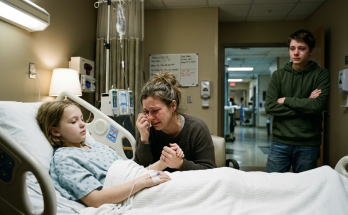
The Empty Plate at Thanksgiving
Part 1
“Don’t give her a plate. She didn’t earn a seat at this table.”
My sister said it while my mother’s hand was hovering over a stack of dinner plates.
For one second, nobody moved.
Steam from the turkey clouded the kitchen windows. Butter hissed in a pan near the stove. From the living room, an announcer called the fourth quarter of the Thanksgiving game while my nephews argued over who had touched the remote.
Everything smelled warm.
Roasted sage. Brown sugar. Coffee.
But the room turned cold so quickly I felt it in my teeth.
My daughter, Lily, sat at the far end of the dining table with her hands folded in her lap. She was ten years old, small for her age, wearing the green cardigan my wife had bought her two weeks earlier.
She pulled the sleeves over her fingers.
That was what she did when she was trying not to cry.
My mother, Carol, looked from the plate to my sister.
“Dana,” she said quietly.
Dana leaned against the counter with a glass of wine in one hand.
“What? She didn’t help cook. She showed up late. The children who contributed eat first.”
“We were twelve minutes late because of the snow,” I said.
Dana shrugged.
“Actions have consequences.”
Lily’s cousins already had full plates. Turkey. Mashed potatoes. Rolls shining with butter. My sister’s youngest son had eaten half his macaroni and was pushing the rest into a pile with his fork.
Lily had nothing.
Not even water.
I looked at my mother.
She lowered her eyes.
My father remained in his chair, staring at the television through the doorway as if the football game required every part of his concentration.
Nobody told Dana to stop.
Nobody reached for a plate.
That silence did more damage than her sentence.
I touched Lily’s shoulder.
“Get your coat.”
My mother exhaled sharply.
“Marcus, don’t make a scene.”
I looked at her.
“I haven’t said anything.”
“That’s exactly what you’re doing.”
I had spent forty-two years learning my family’s language.
If Dana insulted someone, she was being honest.
If Mom defended her, she was keeping peace.
If I reacted, I was making a scene.
Lily slipped down from her chair.
Her sneakers made a faint squeak against the kitchen tile.
Dana took a sip of wine.
“Running away won’t teach her gratitude.”
I stopped beside her.
My hands felt strangely calm.
“What lesson were you trying to teach?”
“That family is earned.”
I looked around the kitchen.
At the refrigerator covered in my nephews’ drawings.
At the framed school photographs of every grandchild except Lily.
At the paper turkeys taped to the cabinets, each one labeled in my mother’s handwriting.
None carried my daughter’s name.
“Thank you,” I said.
Dana smiled.
She thought she had won.
“You finally understand.”
“I do.”
I helped Lily into her coat.
My mother followed us to the front door carrying a plastic container.
“At least take some food.”
I looked through the clear lid.
Two dry pieces of turkey. No sides. No dessert.
The scraps people packed after everyone else had chosen what they wanted.
“No.”
“Marcus, be reasonable.”
“I’m being very reasonable.”
My father finally appeared in the hallway.
“You’re going to tear this family apart over a plate?”
“No,” I said. “I’m leaving because you all decided the plate belonged to people who treated my daughter like family.”
His face hardened.
“Blood matters.”
Lily heard him.
I saw it in the way her shoulders folded inward.
She had come to us through foster care three years earlier. My wife, Elena, and I adopted her just before her eighth birthday.
She knew exactly what blood meant when adults used the word like a locked door.
I opened the front door.
Snow had begun falling over the street, soft and wet beneath the porch light.
Dana called from the kitchen.
“You’ll come back when you stop being dramatic.”
I didn’t answer.
At home, I made Lily a grilled cheese sandwich and tomato soup. She ate on the couch beneath a blue blanket while a cartoon played quietly.
After three bites, she looked at me.
“Was Aunt Dana right?”
“No.”
“I could have helped.”
“You weren’t asked to.”
“Maybe if I do more next time—”
“There won’t be a next time.”
She looked frightened.
Not relieved.
Children who have lost homes do not always hear boundaries as protection. Sometimes they hear another door closing.
I sat beside her.
“You didn’t lose anyone tonight,” I said. “They lost the right to treat you that way.”
She nodded, but I could tell she was not ready to believe me.
After Lily fell asleep, I went into my home office.
The clock on the desk read 11:48 p.m.
I opened my laptop and signed into the account labeled Family Reserve.
The balance was $186,442.17.
My parents’ mortgage, Dana’s rent, my brother’s truck, two utility accounts, and half a dozen smaller payments all came from that money.
I selected Manage Automatic Payments.
Before I clicked anything, an unfamiliar transaction caught my eye.
A withdrawal made three days earlier.
$24,000.
The description read:
L. Foster Placement Settlement.
And the authorization carried my mother’s name.
Part 2
My name is Marcus Reed.
I own a commercial heating and electrical company in Akron, Ohio. Twelve employees, four service vans, one receptionist who frightens late-paying contractors more effectively than any lawyer.
I started as an apprentice at nineteen.
By thirty, I had my master licenses.
By thirty-five, I had a company.
Nobody handed it to me.
I spent winters crawling beneath buildings where frozen pipes dripped down my neck. I missed birthdays because a nursing home lost heat. I drove through lake-effect snow to restart boilers for people who never asked how the technician got home.
Money came slowly.
Then it came steadily.
My family noticed.
At first, helping felt good.
Dad needed a new furnace after his second heart attack. I installed one at cost and paid my crew myself.
Mom fell behind on property taxes. I covered them.
Dana and her husband, Eric, lost their apartment after he changed jobs. I paid the deposit on another place.
My younger brother, Scott, broke his wrist and could not drive his delivery route. I covered three truck payments.
Each favor arrived with the same promise.
Just until we catch up.
Nobody caught up.
Instead, help became infrastructure.
I created the Family Reserve because midnight requests were exhausting. Mom and Dana received cards connected to the account for groceries and emergencies. Bills came out automatically.
I told myself the arrangement was efficient.
Elena called it dangerous.
“They’ve stopped asking whether they can afford things,” she told me one night. “They only ask whether you can.”
I defended them.
“They’re family.”
“So are we.”
At the time, Lily had lived with us for six months.
She was seven and still slept with her shoes beside the bed in case she needed to leave quickly.
Elena understood what I was too slow to see.
Family was not a word.
It was the place where vulnerability was safe.
Now I stared at the twenty-four-thousand-dollar withdrawal.
The bank’s transaction details showed that the money had been transferred to an account at Buckeye Community Trust.
The recipient name was partially hidden.
L. Reed Family Placement Fund.
Lily’s full legal name was Lily Grace Reed.
Before the adoption, her last name had been Mercer.
I clicked the authorization record.
My mother had used her debit credentials, but the transaction exceeded her normal limit. Someone had approved it through a verification call.
The bank listed the caller as Marcus Reed.
I had made no call.
My pulse began beating in my wrists.
I downloaded every record and froze both authorized cards.
Then I called the credit union’s emergency line.
The representative asked security questions.
Date of birth.
Last four digits.
Recent deposits.
“Did you authorize a transfer for twenty-four thousand dollars on Tuesday?” she asked.
“No.”
“Do you know a Carol Reed?”
“She’s my mother.”
“Mrs. Reed initiated the request online. A male caller completed voice verification.”
“Do you have the recording?”
“It can be retained for investigation.”
“Retain everything.”
The woman’s tone changed.
“Mr. Reed, the caller answered questions related to your business account and your daughter’s adoption.”
Cold moved through me.
“What questions?”
“I’m not permitted to disclose that until the fraud team reviews the call.”
“Was my daughter’s Social Security number used?”
A pause.
“Yes.”
I stood.
The office seemed too small.
Only Elena and I kept copies of Lily’s adoption documents. Our attorney had one set. The county had another.
My mother had never been given Lily’s Social Security number.
Unless she had found it in our house.
I walked to the locked cabinet where I kept family records.
The adoption folder was inside.
So was Lily’s birth certificate.
At first, everything appeared normal.
Then I noticed the staple holding the placement agreement.
It had been removed and replaced.
The original document had six pages.
Only five remained.
Page four was missing.
That page described a protected fund established after Lily’s biological mother died in a workplace accident.
The fund was not large enough to make her wealthy, but it was meant to support medical care and education.
I had almost forgotten it because we had never touched the money.
I called our adoption attorney, Miriam Cole.
She answered on the fifth ring, her voice thick with sleep.
“Marcus?”
“I’m sorry. I need to ask about Lily’s settlement fund.”
Silence.
“What happened?”
“Someone transferred twenty-four thousand dollars using her information.”
“That should be impossible.”
“My mother’s name is on the transaction.”
Another silence.
This one longer.
“Marcus, listen carefully. Do not confront anyone tonight.”
“Why?”
“Because your mother called my office last month.”
My grip tightened around the phone.
“What did she want?”
“She asked whether adoptive grandparents could access placement compensation if the adoptive parents became financially unstable.”
“I’m not financially unstable.”
“I told her that.”
“What else did she ask?”
Miriam lowered her voice.
“She asked what would happen to Lily’s trust if you and Elena lost custody.”
Part 3
I did not sleep.
At two in the morning, Dana called.
Her name flashed across my phone three times before I answered.
“What did you do?” she shouted.
“I came home.”
“Our rent payment disappeared.”
“Then pay your rent.”
“You promised to cover it through next summer.”
“I promised before you denied my daughter food.”
“She was not denied food. I said the kids who helped should eat first.”
“Every other child had a plate.”
“Because they’re part of the family.”
There it was.
Clearer than anything she had said at dinner.
I turned on the desk lamp and opened a blank document.
“I’m recording this call.”
Her breathing changed.
“You can’t do that.”
“Ohio permits it.”
“You’re threatening me now?”
“No. I’m documenting you.”
She lowered her voice.
“Mom said you would overreact.”
“How did Mom get Lily’s Social Security number?”
Silence.
Not confusion.
Calculation.
“What are you talking about?”
“Twenty-four thousand dollars left my account using Lily’s information.”
“I don’t know anything about that.”
“Did Mom ask you to help?”
“No.”
“Did Eric make a verification call pretending to be me?”
The line went quiet.
Then Dana laughed.
It sounded forced.
“You’ve lost your mind.”
“Did he?”
“Go to bed, Marcus.”
She ended the call.
At 7:15, I drove to the credit union.
The fraud manager, a woman named Rebecca Sloan, met me in a small office with no windows. She wore a navy blazer and kept her pen aligned perfectly with the edge of her notebook.
She played the verification recording.
A man’s voice answered the security questions.
It was not Eric.
It was my father.
He gave my date of birth.
My business tax number.
The month Lily’s adoption became final.
Then the bank representative asked why he was requesting the transfer.
“For placement reimbursement,” Dad said. “My wife and I have provided care that was never properly compensated.”
The representative asked whether he was Marcus Reed.
Dad said yes.
I closed my eyes.
My father’s voice had changed with age, but I would have recognized it inside a crowded stadium.
Rebecca stopped the recording.
“Do you wish to file a formal fraud claim?”
“Yes.”
“This may result in criminal referral.”
“I understand.”
“Are you certain?”
The question angered me.
Not because she asked.
Because part of me still hesitated.
He was my father.
The man who taught me to change a tire.
The man who attended my first licensing ceremony.
The man who had just impersonated me to take money connected to my daughter.
“Yes,” I said again.
Rebecca showed me the destination account.
It had been opened six weeks earlier by my mother and Dana.
The twenty-four thousand dollars was already gone.
Twelve thousand went to Dana’s landlord as an advance payment.
Seven thousand went to a car dealership.
The remainder was divided between a credit card and cash withdrawals.
The empty plate had not caused the fraud.
It had exposed people already stealing.
I called Elena from the parking lot.
She had spent Thanksgiving with her mother in Michigan, helping after a surgery. I had not told her about dinner the night before because I wanted her to sleep.
When I finished explaining, she said nothing for several seconds.
Then she asked, “Where is Lily?”
“At school.”
“Take her out.”
“You think she’s in danger?”
“I think adults discussing how to remove her from our custody should not know where she is.”
The fear in her voice turned my stomach.
I picked Lily up before lunch.
She climbed into the truck carrying her fox-shaped backpack.
“Am I in trouble?”
“No.”
“Did Grandma call the school?”
I looked at her.
“Why would you ask that?”
She stared down at the zipper on her bag.
“Grandma came last Tuesday.”
The parking lot seemed to tilt.
“What?”
“She said you knew.”
“Where did she take you?”
“She didn’t take me anywhere. She talked to me in the office.”
“What did she say?”
Lily’s fingers tightened around the zipper.
“She asked whether I was happy at home.”
I kept my voice careful.
“What else?”
“She asked if you and Mom fought. She asked if you ever left me alone. She said some children get adopted by people who only want money.”
I could hear my heartbeat.
“Did she tell you not to tell us?”
Lily nodded.
“She said you would get mad and send her away.”
I drove directly back to the school.
The principal pulled the visitor log.
My mother had signed in as Lily’s court-appointed advocate.
Beside her signature was a copy of an official-looking authorization.
The name of the issuing agency was correct.
The seal was not.
And at the bottom of the forged letter was the signature of Lily’s former social worker, a woman who had died eight months earlier.
Part 4
The school called the police.
I called Miriam.
Then I called Elena again and told her to come home.
The principal apologized so many times that the words stopped meaning anything. She showed me security footage of Mom entering the building in a beige coat, carrying a leather folder.
She looked confident.
That was what disturbed me most.
Not nervous.
Not guilty.
Prepared.
A secretary offered her coffee.
A counselor walked Lily into the conference room.
For twenty-three minutes, my mother questioned my daughter behind a closed door.
The school had believed she was authorized.
The forged document had been good enough to fool people who wanted it to be real.
Police took copies.
The fraud claim expanded.
Miriam contacted the county.
By late afternoon, we learned someone had submitted an anonymous report to child protective services accusing Elena and me of financial exploitation, emotional neglect, and leaving Lily unsupervised around electrical equipment.
The report was filed two days after I refused to co-sign Dana’s new SUV.
Its language sounded professional.
Specific.
It mentioned the settlement fund.
Miriam read portions over the phone.
“The caller claimed you adopted Lily to gain access to compensation.”
“We have never withdrawn a dollar.”
“I know.”
“Who filed it?”
“Anonymous reports are protected, but the timing matters.”
I thought of Mom asking Lily whether we fought.
I thought of Dad’s voice impersonating me.
This was no longer a family argument.
It was an attempt to build a case.
The goal was not merely money.
It was custody.
When Elena arrived that evening, she knelt in the entryway and held Lily for a long time.
Lily whispered something into her shoulder.
Elena looked at me over our daughter’s head.
There was fear in her eyes.
And fury.
After Lily went to bed, Elena placed her phone on the kitchen table.
“My mother kept screenshots,” she said.
“Of what?”
“Messages Carol sent her.”
My mother had contacted Elena’s mother, Ruth, several times over the previous month.
The messages began innocently.
Concern about Lily’s adjustment.
Questions about whether Elena seemed tired.
Then they became more direct.
Do you think Marcus and Elena took on too much?
Has Lily ever said she wants another home?
Would you support temporary family placement if they had marital problems?
Ruth had found the questions strange and stopped responding.
Mom continued anyway.
She wrote that Dana had room for another child.
I read that sentence twice.
Dana’s apartment had three bedrooms, but two were already occupied by her sons. She complained constantly about money. She had never offered to babysit Lily for more than an hour.
Why would she want custody?
Then Elena showed me the last screenshot.
Mom had written:
Once placement changes, the monthly support and Mercer trust can be redirected to the responsible household.
There it was.
Not concern.
Revenue.
Elena sat across from me, both hands wrapped around a mug she had not touched.
“You paid their bills while they tried to take our child.”
“I know.”
“You gave them cards.”
“I know.”
“You defended them every time I told you something was wrong.”
“I know.”
Her eyes filled.
“I need you to understand that ‘I know’ does not fix this.”
“I do.”
“No, Marcus. You keep looking like the man who will still find an explanation that lets them remain your family.”
The sentence hurt because it was true.
Some part of me still wanted Dad to say he had been confused.
Mom to say Dana manipulated her.
Dana to say the account was supposed to be repaid.
I wanted one person to be less guilty so I would not have to bury all of them at once.
Elena pushed her phone toward me.
“Your mother sent this an hour ago.”
It was a family group message.
Marcus has become unstable and is withholding essential support. We are worried about Lily and believe she may be unsafe while he is angry.
Replies followed.
Aunt Patricia: Should someone call the county?
Scott: Marcus has been stressed about money.
Dana: I’m scared for my niece.
The same people who left Lily without a plate were now performing concern for her safety.
I took screenshots.
Then I typed one message.
All future contact regarding Lily must go through our attorney. Do not come to our home, her school, or my workplace.
Mom replied immediately.
You cannot keep our granddaughter from us.
I wrote:
You called her an outsider until her trust became useful.
Three dots appeared.
Then disappeared.
No response came.
At midnight, the doorbell camera alerted me.
A car had stopped across the street.
Its headlights remained off.
I zoomed in.
My brother Scott sat behind the wheel.
A second person moved in the passenger seat.
When the interior light came on, I saw Dana holding a camera aimed at our house.
Part 5
I stepped onto the porch with my phone recording.
Scott started the engine.
The car did not move.
“What are you doing?” I called.
Dana lowered the camera.
“We’re checking on Lily.”
“At midnight?”
“We heard yelling.”
“No, you didn’t.”
Scott opened his door but remained seated.
“Mom said Elena came home angry.”
“Elena lives here.”
“You’ve been acting crazy.”
“Because Dad committed bank fraud?”
His face changed.
Dana leaned toward him.
“Don’t talk to him.”
I walked to the end of the driveway.
Snow crackled beneath my shoes.
“Leave.”
“We have every right to make sure our niece is safe,” Dana said.
“You denied her dinner.”
“That was discipline.”
“For what?”
“She needs to learn she can’t just enter a family and expect everyone to rearrange around her.”
My hand tightened around the phone.
“Say that again.”
She saw the screen.
“You’re recording?”
“Yes.”
Dana opened her door.
Scott grabbed her sleeve.
“Get back in.”
She pulled free.
“You think because you have money you can control everybody.”
“No. I’m learning the opposite.”
“You cut off Mom’s mortgage.”
“I stopped paying a debt that is not mine.”
“You stopped our rent.”
“Your husband works.”
“You know his hours were reduced.”
“You bought a twelve-thousand-dollar SUV deposit with money taken using Lily’s identity.”
Her face went pale.
Scott looked at her.
“You said Mom transferred it from Marcus’s family account.”
“She did.”
“Using my name,” I said.
Scott turned toward me.
“Dad said you approved it.”
“Dad impersonated me on a recorded bank call.”
The silence shifted.
For the first time, Scott looked uncertain.
Dana did not.
“Dad would never do that unless he had a reason.”
The sentence settled everything.
Not Did he?
Not That cannot be true.
He must have had a reason.
I pointed toward the street.
“Leave before the police arrive.”
“You called them?”
“I called them when your car stopped.”
Scott pulled Dana back inside.
As they drove away, she lowered the window.
“You’re going to regret choosing her over your real family.”
The words carried clearly through the cold.
My phone captured every one.
The next morning, I met Miriam and a family-law attorney named Samuel Price.
Samuel had kind eyes and the blunt manner of someone who billed by the hour and did not waste either his time or yours.
“You need temporary protective orders,” he said.
“Against my parents and siblings?”
“Against anyone participating in harassment, fraudulent school access, or attempts to manufacture a custody case.”
He reviewed the recordings, messages, bank documents, and school footage.
Then he asked about the original foster placement.
“Did Lily’s biological relatives contest the adoption?”
“No.”
“Any surviving relatives?”
“Her maternal uncle, but he signed consent. He lives in Oregon.”
“Has your family contacted him?”
I did not know.
Samuel called the uncle’s attorney.
An hour later, we had an answer.
My mother had contacted him twice.
She told him Lily had been placed in an unsafe home.
She offered to pay his travel expenses if he would petition to reopen the case.
My stomach turned.
“What did he say?”
“He refused,” Samuel said. “But he kept the emails.”
Mom had attached photographs to support her claims.
One showed Lily crying in our backyard.
I recognized the day.
She had fallen from a swing and scraped her knee.
Another showed Elena holding a glass of wine at a wedding.
The image had been cropped to remove the bride and guests.
A third showed Lily sitting alone in my work van.
She had been waiting for me while I carried supplies into our locked garage. I had been away from her for less than two minutes.
Each photo was real.
Together, they told a lie.
“Who took them?” Elena asked.
The backyard photograph had been taken from my parents’ property during a summer cookout.
The wedding photo came from Dana.
The van photograph had been taken outside my business.
Someone had been collecting material for months.
Samuel leaned back.
“This is coordinated.”
“Because I refused to co-sign a car?”
“No.”
He pointed to the timeline.
“The custody report predates that refusal.”
He was right.
The anonymous complaint had been prepared before the argument about the SUV.
Thanksgiving was not the start.
Neither was the trust transfer.
Something earlier had triggered the plan.
Miriam reviewed the adoption records again.
Then she called me that evening.
“Marcus, I found an amendment filed six months after Lily’s adoption.”
“What kind of amendment?”
“It changes the successor custodian of her trust if you and Elena become unable to serve.”
“To whom?”
“Carol Reed.”
“My mother?”
“Yes.”
“We never agreed to that.”
“I know.”
“Whose signatures are on it?”
“Yours and Elena’s.”
We had signed no amendment.
Miriam’s voice grew quieter.
“There is also a witness signature.”
“Who?”
“Dana.”